Household bills

Council Tax Arrears Assistance Pack

Get your council tax arrears in order if you live in England: sort your notices by stage, rebuild what you owe year by year and compare it with the council's figure, work out a household budget, and prepare a repayment offer and letters to the council. A step-by-step guide, an Excel workbook, five editable letters and a worked fictional example.

For customers in the UK only.

One-off payment. Instant download, with the link emailed to you. Digital product, nothing is posted.

Microsoft Excel (.xlsx), Word (.docx), PDF. Tested in Microsoft 365 desktop Excel and Word on Windows. Not tested on a Mac, a phone or tablet, in Excel for the web, Google Sheets, Apple Numbers or LibreOffice. No macros. Read the limitations before you buy

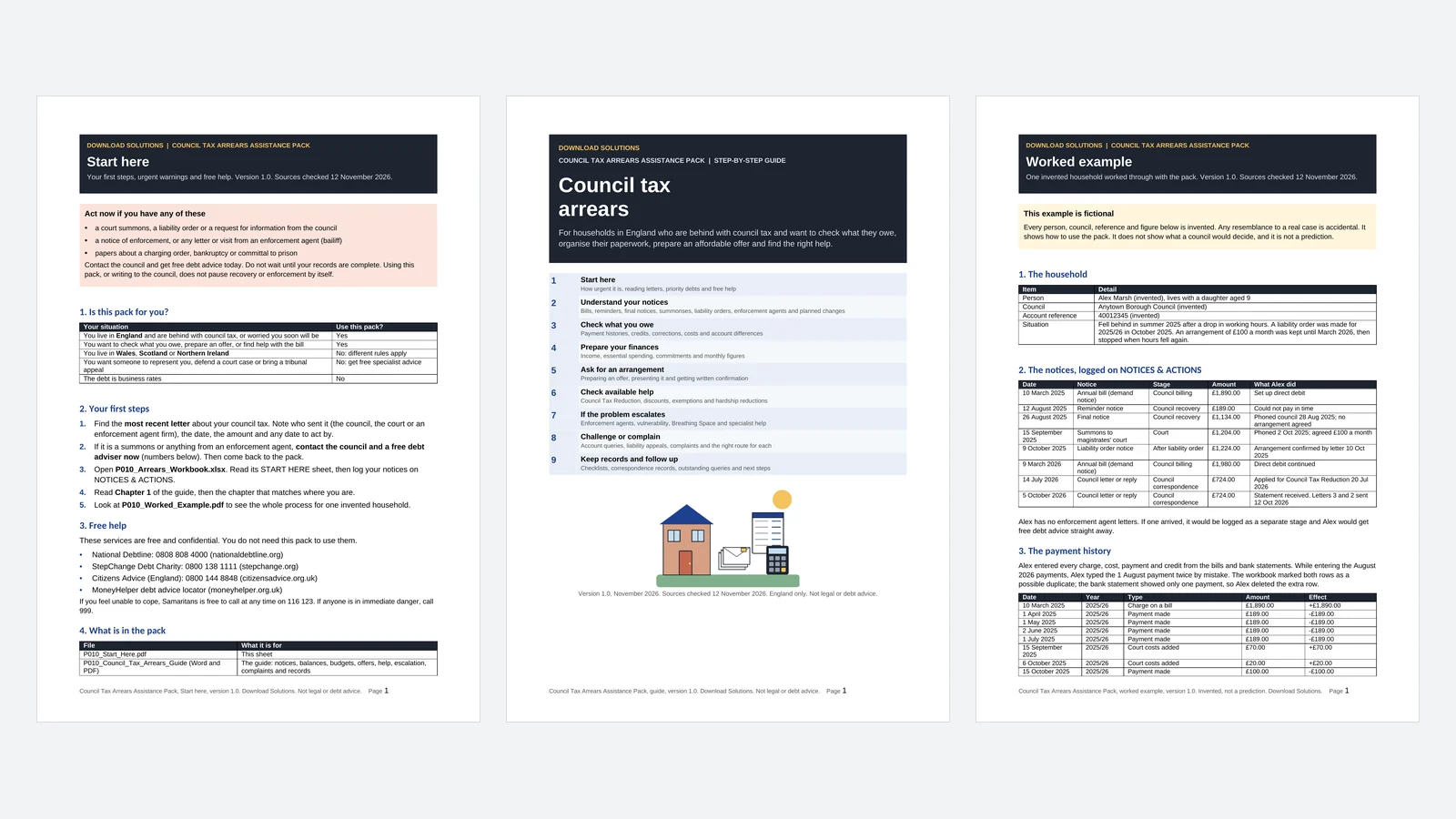
Three pages from the pack side by side: the Start here sheet with its act now warnings, the cover of the guide listing its chapters, and the first page of the worked fictional example

The problem

Council tax arrears come with a pile of paperwork, changing balances and dates that matter.

Falling behind with council tax usually means a run of letters: bills, reminders, a final notice, perhaps a court summons and a liability order, and sometimes letters from an enforcement agent firm. Each comes from a different stage, often with a different balance, and some ask you to act by a date. Council tax counts as a priority debt, so it is worth getting on top of quickly.

The hard part is often practical. You need to know which letters matter most, what you have actually paid against which year, whether the council's figure matches your own records, and what you can genuinely afford to offer. Without that, it is hard to write to the council clearly or to make an offer you can keep up.

This pack helps you sort the notices, rebuild each year's balance from your bills and bank statements, set out a household budget and prepare an offer and letters in your own words. It does not decide what you owe, it contacts and submits nothing, and it cannot stop recovery or promise that the council will agree. Free, confidential debt advice is available, and you do not need this pack to use it.

What it does for you

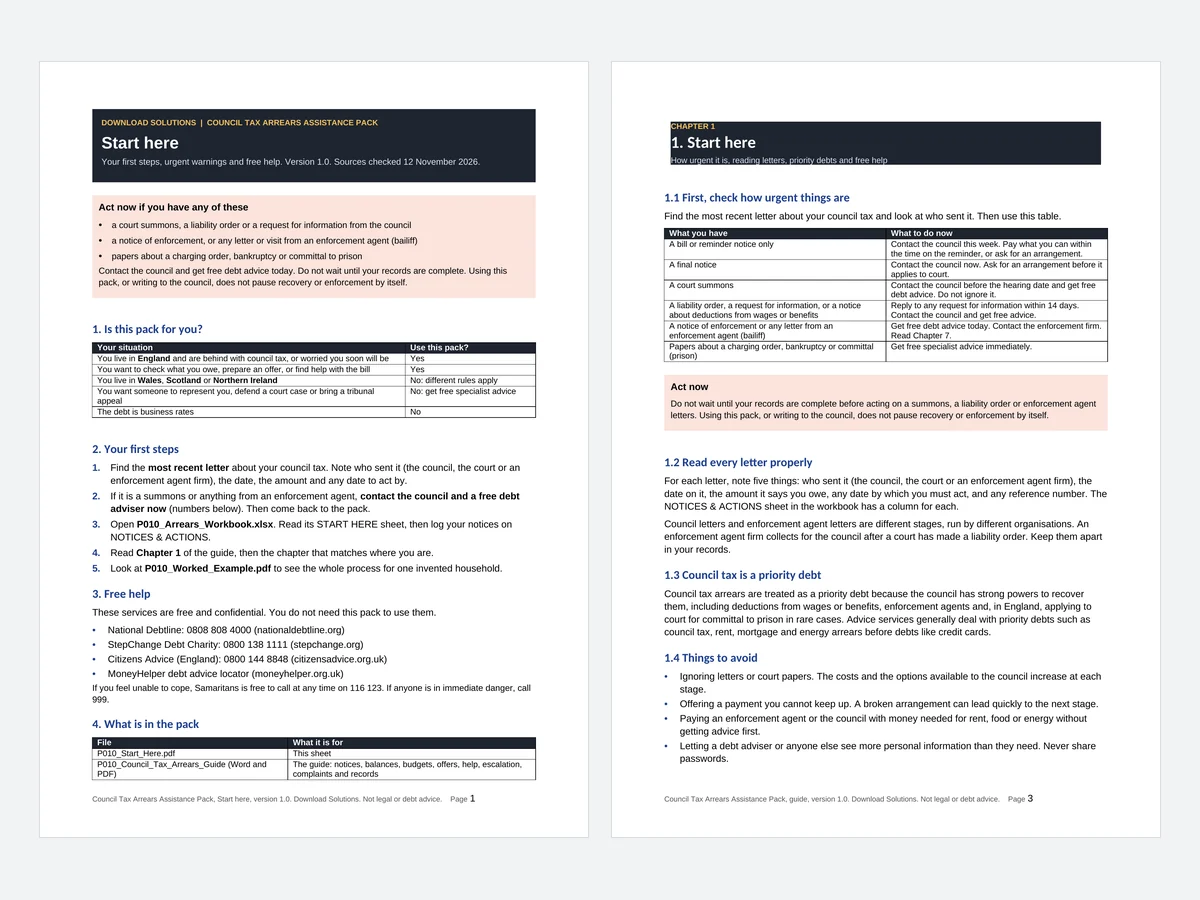
The first page of the Start here sheet with its act now warnings, beside chapter 1 of the guide with a table of what you have and what to do now

01

Work out how urgent things are, first

A two page Start here sheet and the first chapter of the guide help you find your most recent letter, see who sent it and what to do now, from a reminder to an enforcement agent letter. They tell you plainly when to get free debt advice today, and that using the pack or writing to the council does not pause recovery by itself.

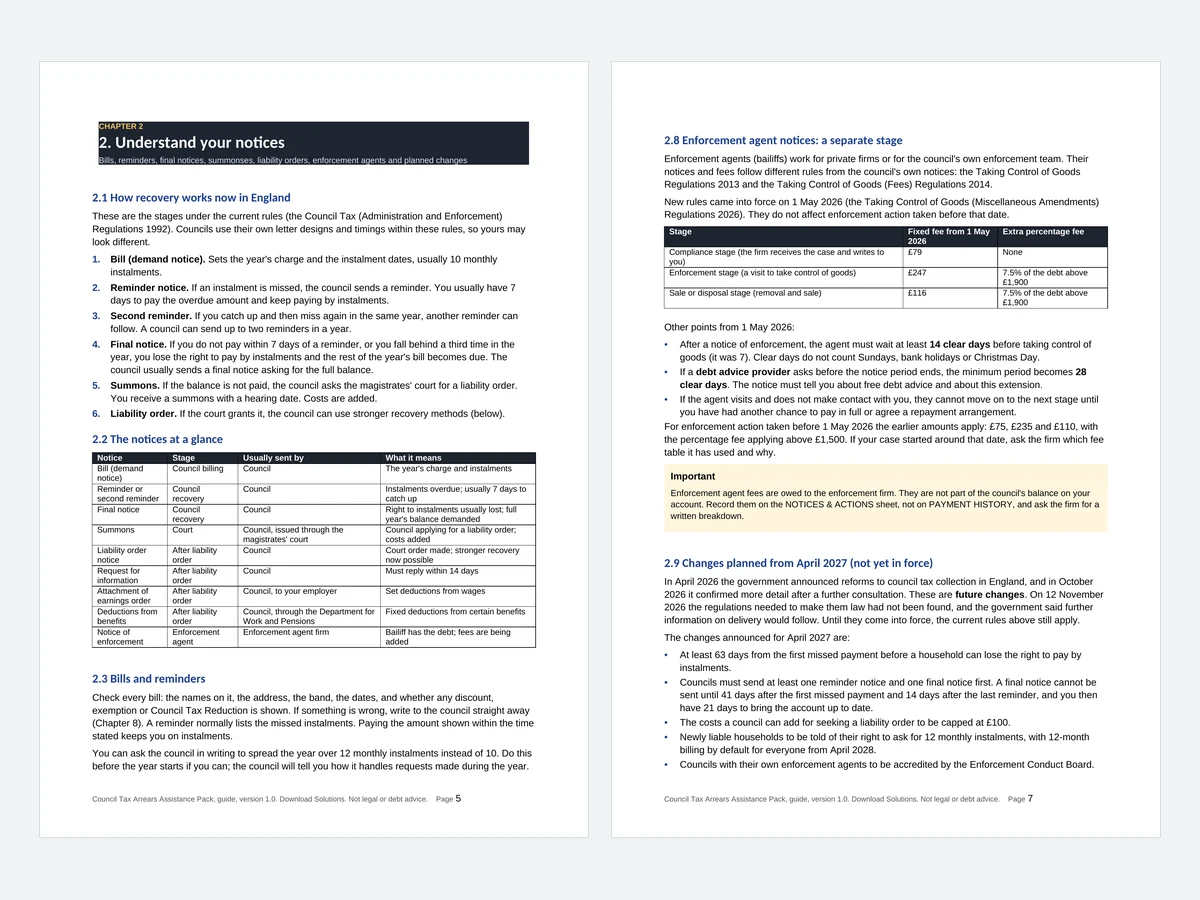
Two pages from chapter 2 of the guide: the stages of council tax recovery in England, and the separate stage of enforcement agent notices with their fees

02

Understand each notice and which stage you are at

The guide explains the current recovery steps in England in plain words: bill, reminder, final notice, summons, liability order and what can follow. It keeps enforcement agent notices and their fees separate from the council's own balance, and it sets out the changes announced for April 2027 as planned changes, not rules already in force. The NOTICES & ACTIONS sheet logs each letter with its date, amount and the date to act by.

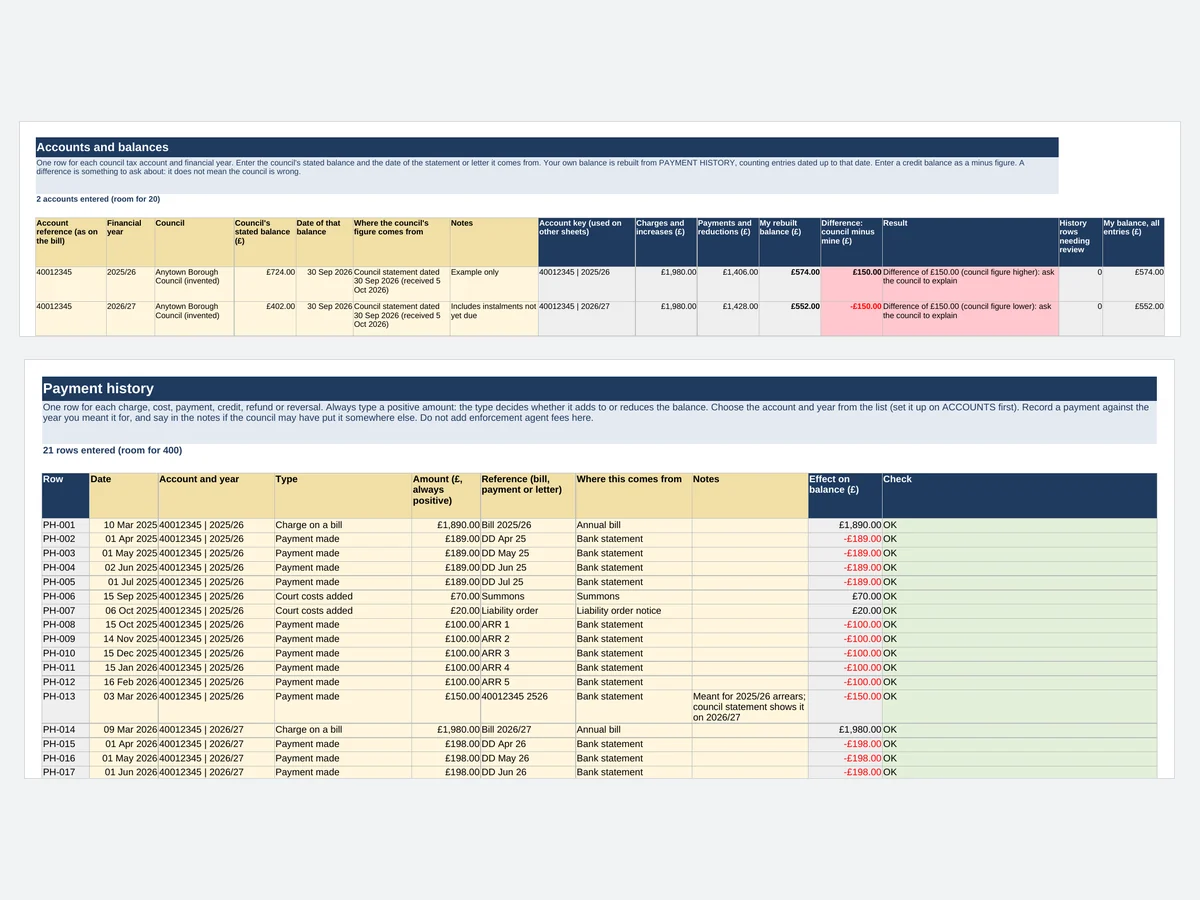
The ACCOUNTS and PAYMENT HISTORY sheets of the workbook filled in with the invented example, showing the council's figure, the rebuilt balance and a difference of £150 to ask about for each year

03

Rebuild what you owe and compare it with the council's figure

Enter every bill, cost, payment and credit from your own records, and the workbook rebuilds each year's balance up to the date of the council's statement. It shows any difference from the council's figure as something to ask about, not proof of a mistake, and it flags rows that need checking, such as possible duplicates. It does not decide which figure is right.

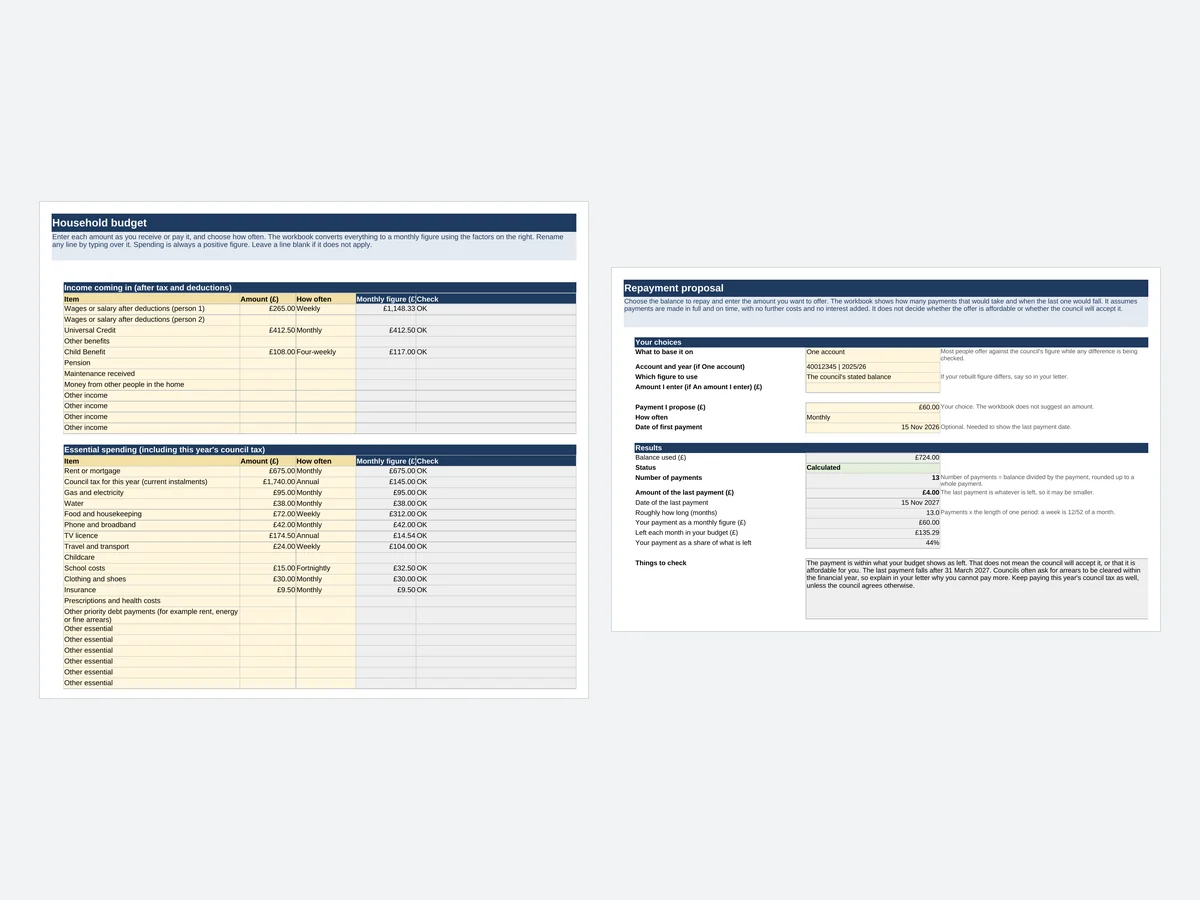
The HOUSEHOLD BUDGET sheet filled in with the invented example's income and spending converted to monthly figures, beside the REPAYMENT PROPOSAL sheet showing the number of payments and the last payment date

04

Set out your budget and a repayment offer you can keep

The HOUSEHOLD BUDGET sheet turns weekly, four-weekly and yearly amounts into monthly figures, including this year's council tax, and shows what is left after essentials. On REPAYMENT PROPOSAL you choose the balance and the amount to offer, and the workbook shows how many payments that takes and when the last one falls. The amount is always your choice; the workbook does not suggest one.

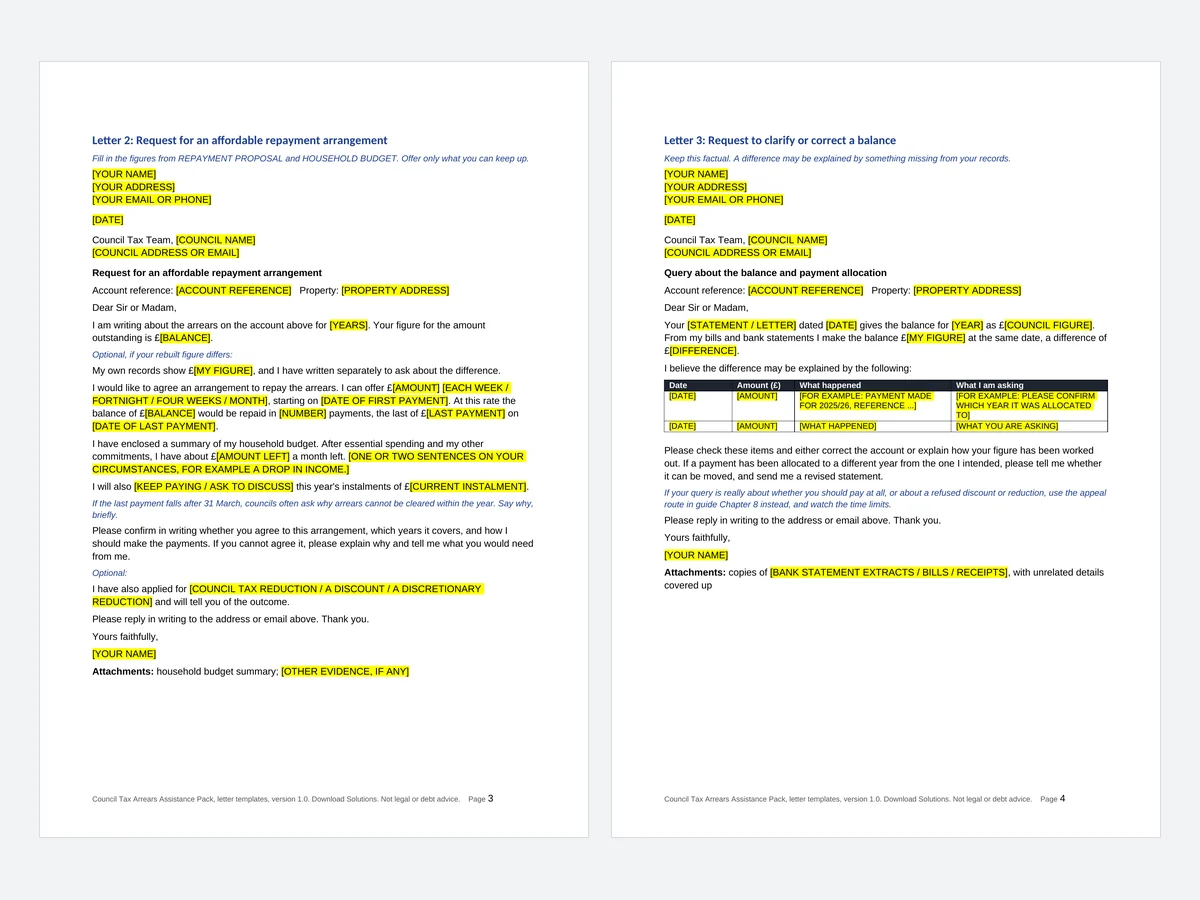
Two pages from the letter templates: letter 2 requesting an affordable repayment arrangement, and letter 3 asking the council to clarify or correct a balance, with placeholders in square brackets

05

Five editable letters to the council

Editable Word letters help you ask for a full account statement, propose an affordable repayment arrangement, ask the council to explain or correct a balance, ask about discounts, Council Tax Reduction or hardship help, and ask the council to take vulnerability into account. Each placeholder is marked in square brackets, and the wording stays factual and polite.

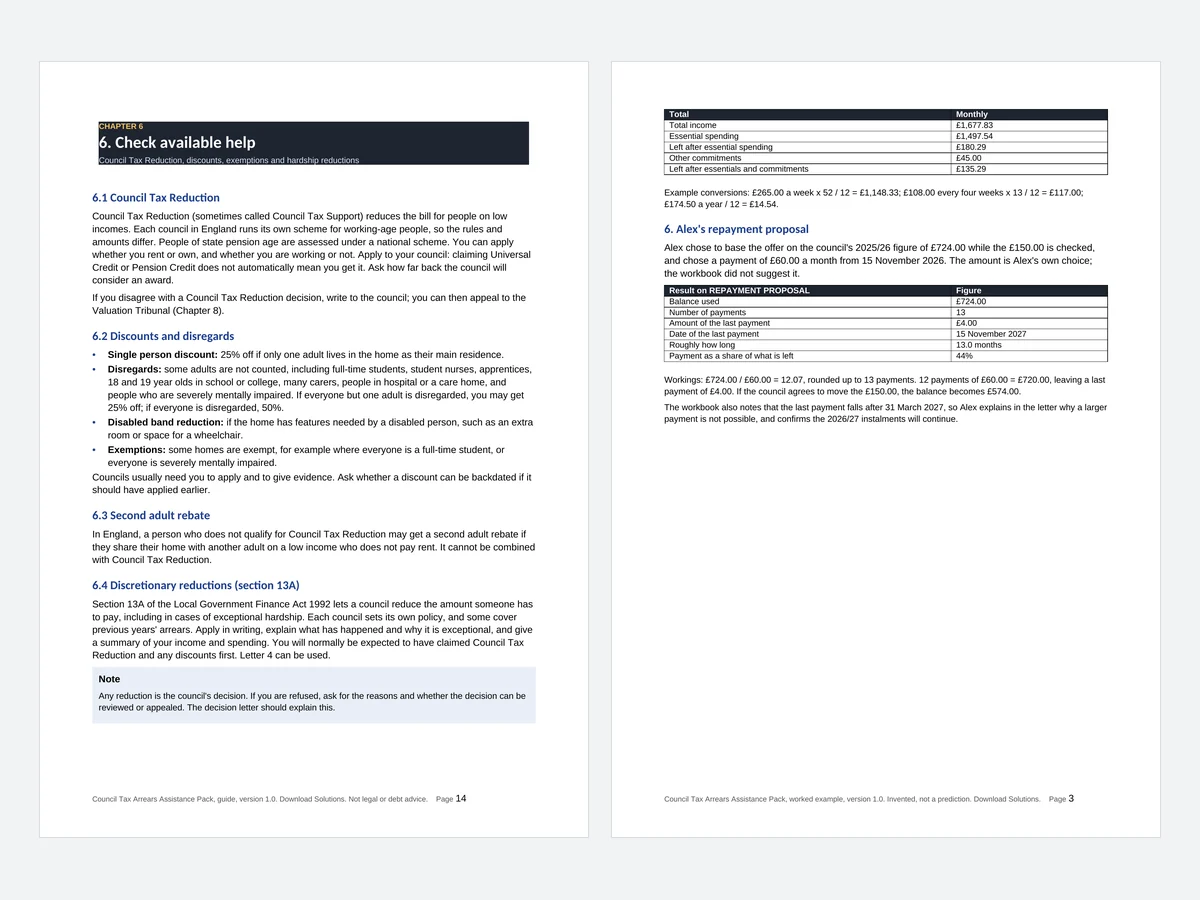
Chapter 6 of the guide on Council Tax Reduction and discounts, beside a page of the worked fictional example showing the household's monthly budget totals

06

Help that could reduce the bill, and a worked fictional example

The guide covers Council Tax Reduction, discounts and disregards and discretionary reductions, so you can check what you might claim alongside your offer. An invented household is then worked through from the first bill to a written offer, including a £150 payment that may have been put against the wrong year. It does not show or predict what a council would decide.

Is it right for you?

A good fit if

  • You live in England and are behind with council tax, or worried you soon will be.
  • You have a stack of council letters and want to know which stage you are at and what each one asks of you.
  • You want to check the council's stated balance against your own bills and bank statements before you agree a figure.
  • You want to work out what you can afford and put a clear, written repayment offer to the council.
  • You use Microsoft Excel and Word on a Windows computer and are comfortable typing into a spreadsheet.

Not the right choice if

  • You have enforcement agent (bailiff) letters, a charging order, bankruptcy or committal papers, or a hearing very soon. Get free debt advice today from a service such as National Debtline, rather than starting with paperwork.
  • You want someone to tell you whether you are liable, how much you owe, what you can afford or what the council will accept. The pack cannot, and nothing can promise a result.
  • You want to defend court proceedings, appeal to the Valuation Tribunal or bring a formal complaint. The pack explains these routes in outline only and points you to free specialist advice.
  • The property is in Wales, Scotland or Northern Ireland, where the rules are different.
  • You will be using a Mac, a phone, a tablet, Excel for the web or Google Sheets. The files have only been tested in desktop Microsoft Excel and Word on Windows.

What is in the download

Start here (PDF)
Two pages to read first: urgent warnings, whether the pack fits your situation, your first steps and free help.
Council tax arrears guide (Word and PDF)
Twenty-one pages in nine chapters: start here, understand your notices, check what you owe, prepare your finances, ask for an arrangement, check available help, if the problem escalates, challenge or complain, and keep records and follow up, with a dated list of sources.
Arrears workbook (Excel)
Seven sheets: START HERE, ACCOUNTS, PAYMENT HISTORY, NOTICES & ACTIONS, HOUSEHOLD BUDGET, REPAYMENT PROPOSAL and SUMMARY, with your typing cells unlocked and the formulas protected.
Letter templates (Word)
Five editable letters: request for a full account statement, request for an affordable repayment arrangement, request to clarify or correct a balance, enquiry about discounts, Council Tax Reduction or hardship help, and request to consider vulnerability.
Worked fictional example (PDF)
Five pages showing one invented household worked through with the pack, from the notices to a written repayment offer.

Microsoft Excel (.xlsx), Word (.docx), PDF. Tested in Microsoft 365 desktop Excel and Word on Windows. Not tested on a Mac, a phone or tablet, in Excel for the web, Google Sheets, Apple Numbers or LibreOffice. No macros. Version 1.0, last updated 12 November 2026.
Before you buy: the limitations

  • It is a self-help pack for organising your information, not legal advice or regulated debt advice. It does not decide whether you are liable, what you owe or what you can afford. It does not contact the council, a court or an enforcement agent for you and submits nothing to anyone. No council, court, government department or advice service produced, endorsed or approved it, and you remain responsible for what you send and for acting by the dates on your own letters.
  • Using the pack, or sending a letter or an offer, does not by itself pause or stop recovery or enforcement, and a council does not have to accept a repayment offer. Councils set their own procedures within the rules, so what yours does may differ from the guide. See GOV.UK's page on council tax arrears for the official overview.
  • The workbook does not check the council's calculations for you. It rebuilds a balance only from the entries you type in, and a difference from the council's figure is a question to ask, not proof that either figure is wrong.
  • It covers England only. Wales changed its council tax recovery rules from 1 April 2026, and Scotland and Northern Ireland have their own systems.
  • The rules and guidance were checked on 12 November 2026. The government has announced changes to council tax collection in England for April 2027; the guide describes them as planned changes, and the current rules apply until they come into force. Rules can change after that date, so check the dated sources in the guide if you are reading much later.
  • You do not need this pack to get help. Free, confidential debt advice is available from National Debtline, StepChange and Citizens Advice, and GOV.UK lists more on its page about free debt advice. The pack can be used alongside them and gives you no special standing with any council or adviser.
  • It was tested in Microsoft 365 desktop Excel and Word on Windows. The files have not been tested on a Mac, a phone or tablet, in Excel for the web, Google Sheets, Apple Numbers or LibreOffice, so they may not look or work the same there. The pack does not send your information anywhere: what you type stays in the files on your own computer unless you choose to share them, and we do not want your council tax letters or personal details.

Questions

Will this pack stop enforcement or a court summons?

No. Nothing in the pack, and no letter on its own, pauses or stops recovery or enforcement. If you have a summons, a liability order or any enforcement agent letter, contact the council and get free debt advice straight away, without waiting until your records are complete.

Does the council have to accept my repayment offer?

No. A council does not have to accept an offer, and councils handle arrangements in their own ways. The pack helps you base an offer on a clear budget and put it in writing, which gives the council what it needs to consider it. It cannot promise any outcome.

Does it check the council's figures automatically?

No. The workbook rebuilds each year's balance from the bills, costs, payments and credits you enter, and shows any difference from the council's stated figure. A difference is something to ask the council about. The workbook does not know the council's own records and cannot say which figure is right.

Is this legal or debt advice?

No. It is a self-help pack for organising your information and preparing your own letters. It does not decide whether you are liable, what you owe or what you can afford. For advice on your own situation, use a free debt advice service.

Where can I get free help?

National Debtline, StepChange and Citizens Advice all give free, confidential debt advice, and GOV.UK lists other free services. Many councils can also help directly or refer you to local advice. You do not need this pack to use any of them.

What files do I get, and what software do I need?

Six files in one download: a Start here PDF, the guide in Word and PDF, an Excel workbook, the letter templates in Word and a worked example PDF. You need Microsoft Excel and Word on Windows to use the workbook and letters as tested. The PDFs open in any ordinary PDF reader.

Will it work on a Mac or in Google Sheets?

It has not been tested there. The files were tested in Microsoft 365 desktop Excel and Word on Windows only, so they may not look or work the same on a Mac, a phone or tablet, in Excel for the web or in Google Sheets.

Does it apply outside England?

No. It covers England only. Wales changed its recovery rules from 1 April 2026, and Scotland and Northern Ireland have their own systems, so the steps and time limits in the guide do not apply there.

Buy once, keep the files

One-off payment. Ready to download straight away, with the link emailed to you.

£9.99

Buy and download