Household bills

Energy Bill Reconciliation & Dispute Evidence System

Check your gas and electricity bills against your own meter readings, prices and payments in one Excel workbook, see which bills do not add up, and put together clear evidence for a query or complaint to your supplier. With a step-by-step guide, a completed example and a complaint letter template.

For customers in the UK only.

One-off payment. Instant download, with the link emailed to you. Digital product, nothing is posted.

Microsoft Excel (.xlsx), Word (.docx), PDF. Tested in Microsoft 365 desktop Excel and Word (Version 2610) on Windows. Not tested on a Mac, in Excel for the web, Google Sheets, Apple Numbers or LibreOffice. No macros. Read the limitations before you buy

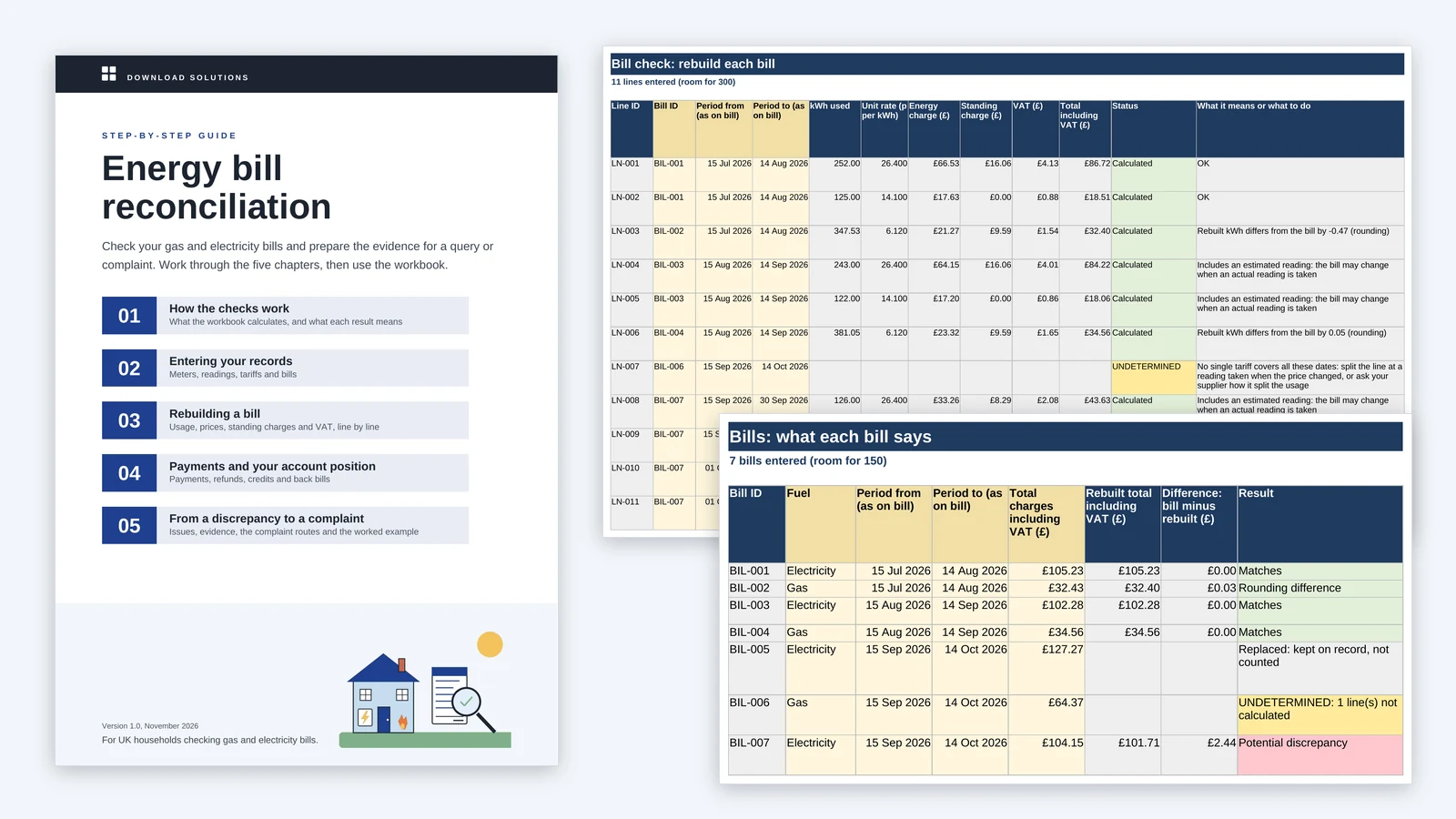
The guide cover beside the BILL CHECK sheet, which rebuilds each line of a fictional household's bills, and the BILLS sheet showing a result for each bill

The problem

Energy bills are hard to check, and harder to question without your records in order.

A household energy account soon becomes a tangle of bills, estimated readings, price changes, standing charges, Direct Debits and credits. Each bill shows a total, but working out whether it is right means going back to the readings, the unit rates, the number of days and the VAT, often across a change of price in the middle of a bill.

When something looks wrong, it is easy to lose track of which bill, which reading and which payment you are asking about. Ofgem suggests that a complaint says exactly what the problem is and when it happened, with evidence such as photos of meter readings and statements, and that takes records you can find.

This system rebuilds each bill from the figures printed on it and your readings, follows the money on your account from a balance you trust, and keeps your issues and evidence in one place. Where it cannot check something exactly, it says so rather than guess.

What it does for you

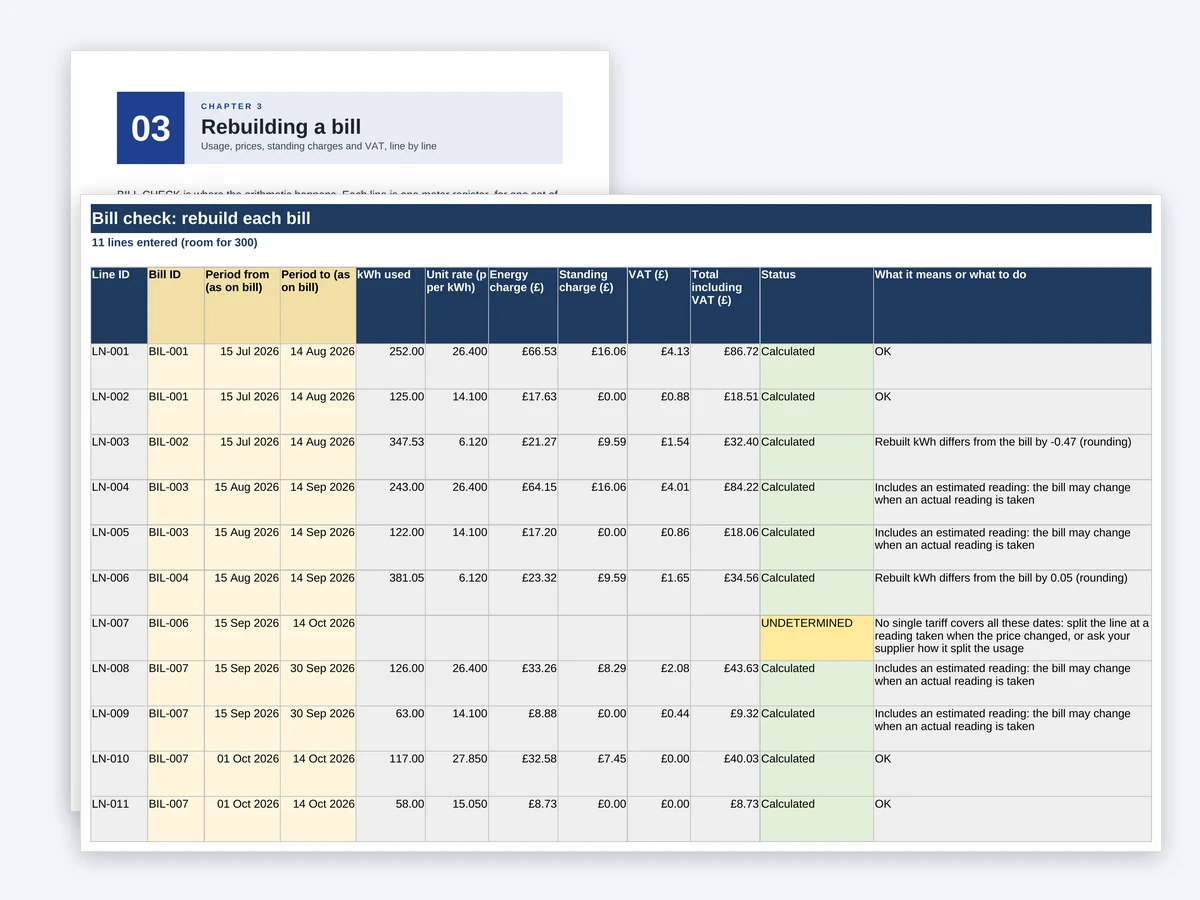
The BILL CHECK sheet for the fictional example, with eleven lines showing kWh used, unit rate, energy charge, standing charge, VAT, total, status and what each result means, in front of the guide's chapter on rebuilding a bill

01

Each bill rebuilt, line by line

Copy the readings, unit rates, standing charges and VAT rate from your bills. BILL CHECK works out the units used, the energy charge, the standing charge and the VAT for each meter register and price period, and adds them up. It handles single-rate and two-rate electricity meters and converts gas meter readings, metric or imperial, into kWh using the figures on your bill.

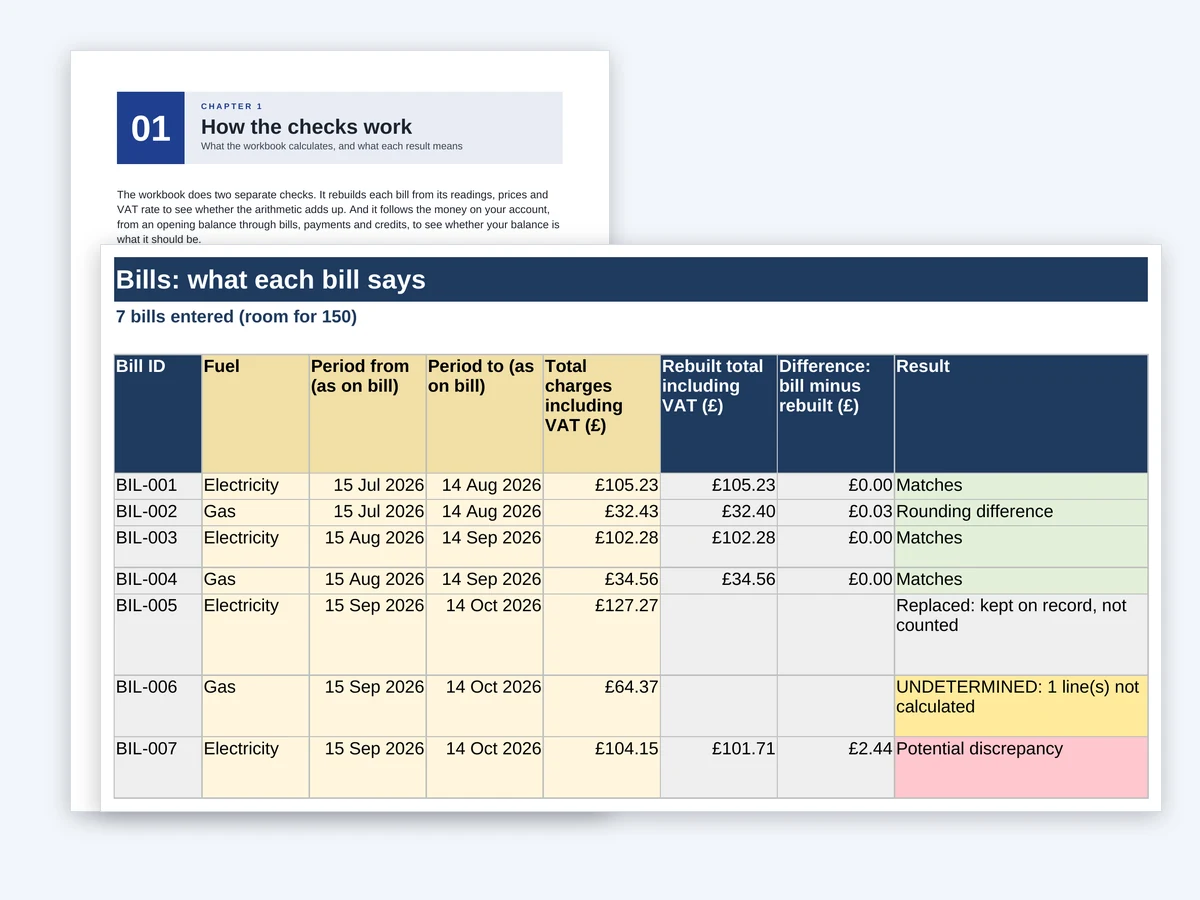
The BILLS sheet listing seven fictional bills with their totals, rebuilt totals, differences and results, including Matches, a rounding difference, a replaced bill, an UNDETERMINED bill and a potential discrepancy of £2.44

02

A plain result for every bill

Each bill gets a plain result, such as Matches, Rounding difference, Potential discrepancy or UNDETERMINED. A potential discrepancy is a reason to ask your supplier, not proof of an error. Estimated readings are labelled, and a bill that has been replaced stays on record without being counted twice. The workbook never says a bill has passed.

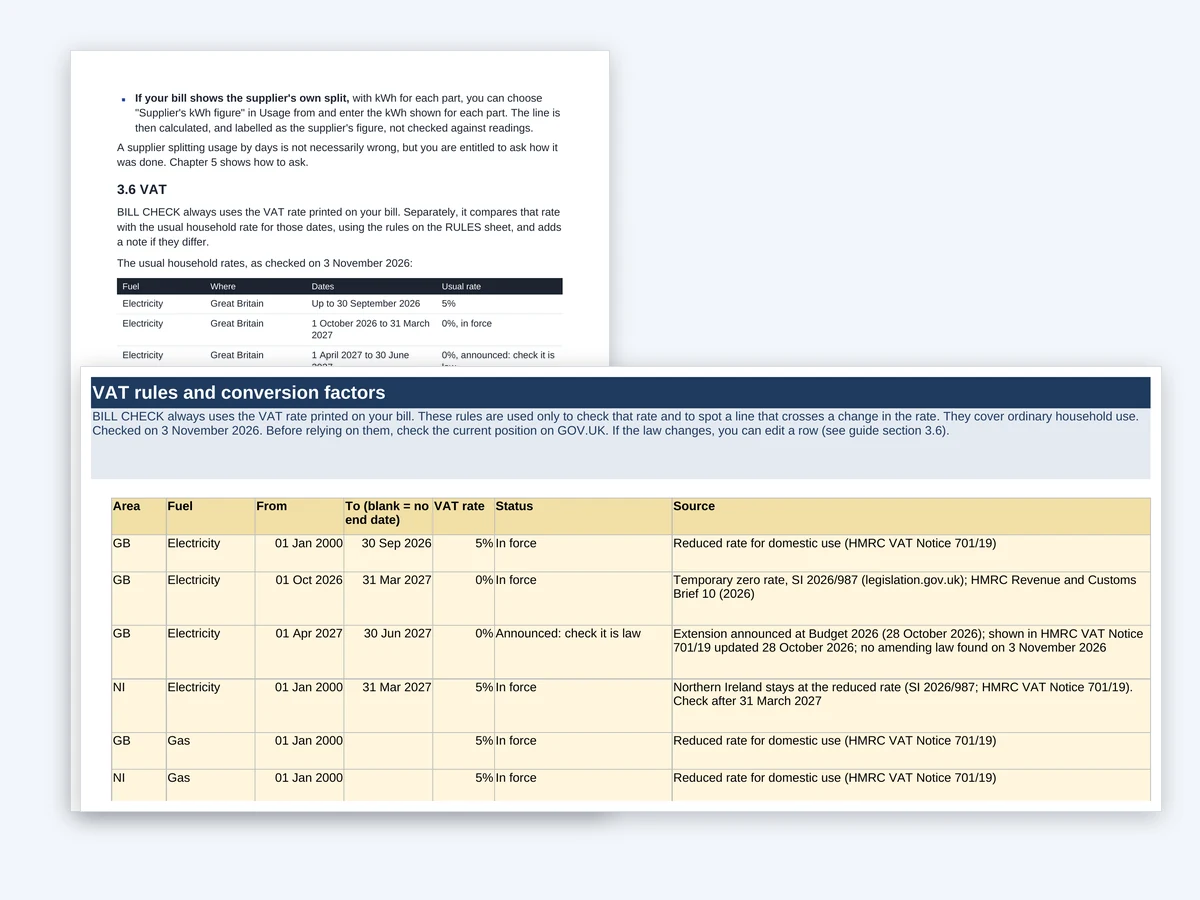
The RULES sheet listing household VAT rates for electricity and gas in Great Britain and Northern Ireland, with the April to June 2027 zero rate marked as announced and to be checked, in front of the guide's section on VAT

03

Price and VAT changes handled carefully

If the price or VAT rate changed during a bill, the workbook asks for a reading taken on the day of the change and never shares your usage out by days. Without one, the line is UNDETERMINED, unless the bill shows the supplier's own split, and you are told what to ask your supplier. It always uses the VAT rate printed on your bill, and checks it against a table of the usual household rates, with their sources, which you can update if the law changes.

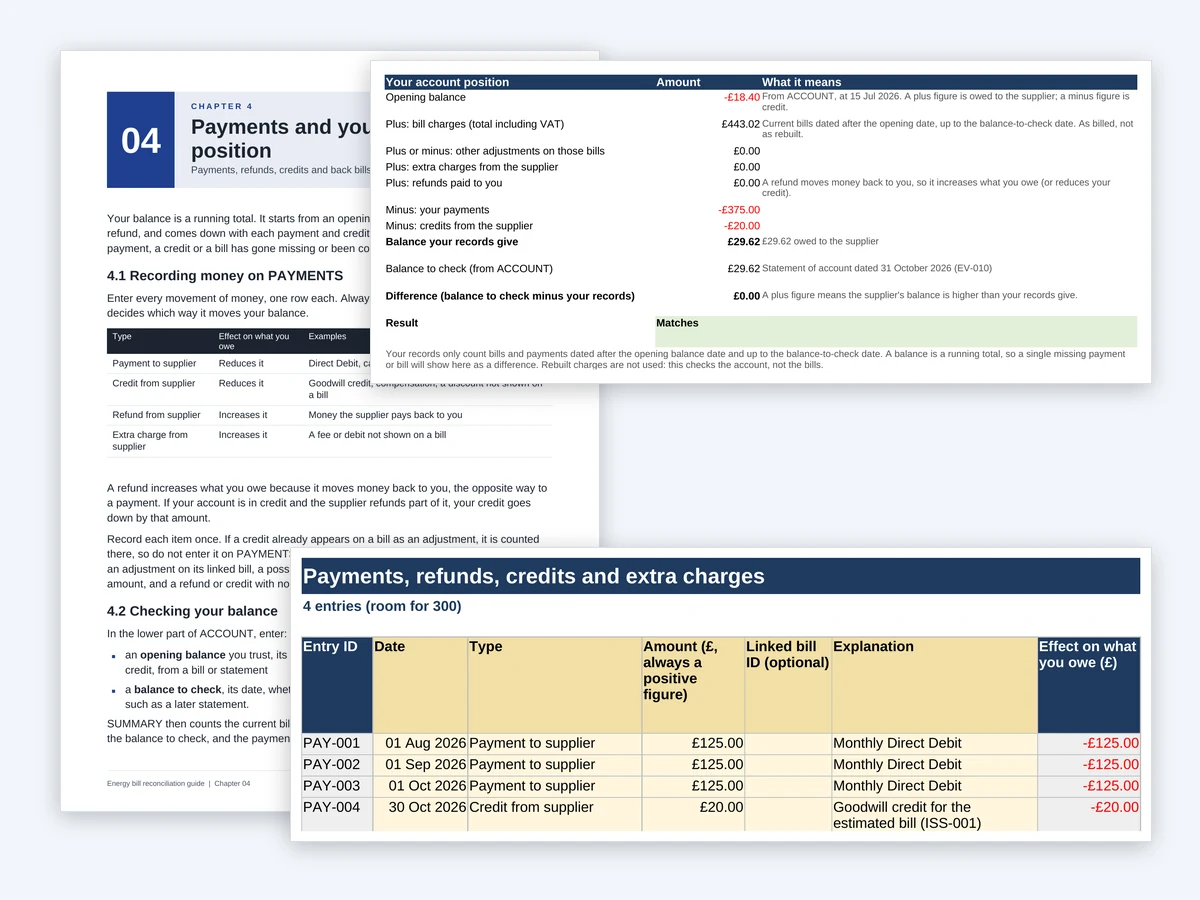
The account position on the SUMMARY sheet, from an opening balance of £18.40 in credit to £29.62 owed, matching the supplier's statement, above the PAYMENTS sheet with three Direct Debits and a goodwill credit

04

Your account balance followed through

Record a balance you trust from a bill or statement, then every bill, payment, refund, credit and extra charge. SUMMARY works out what your balance should be on a later date and compares it with what your supplier says, so a missing payment, a credit counted twice or a bill charged twice shows up. It uses the bills as billed, so this checks the account, not the arithmetic of each bill.

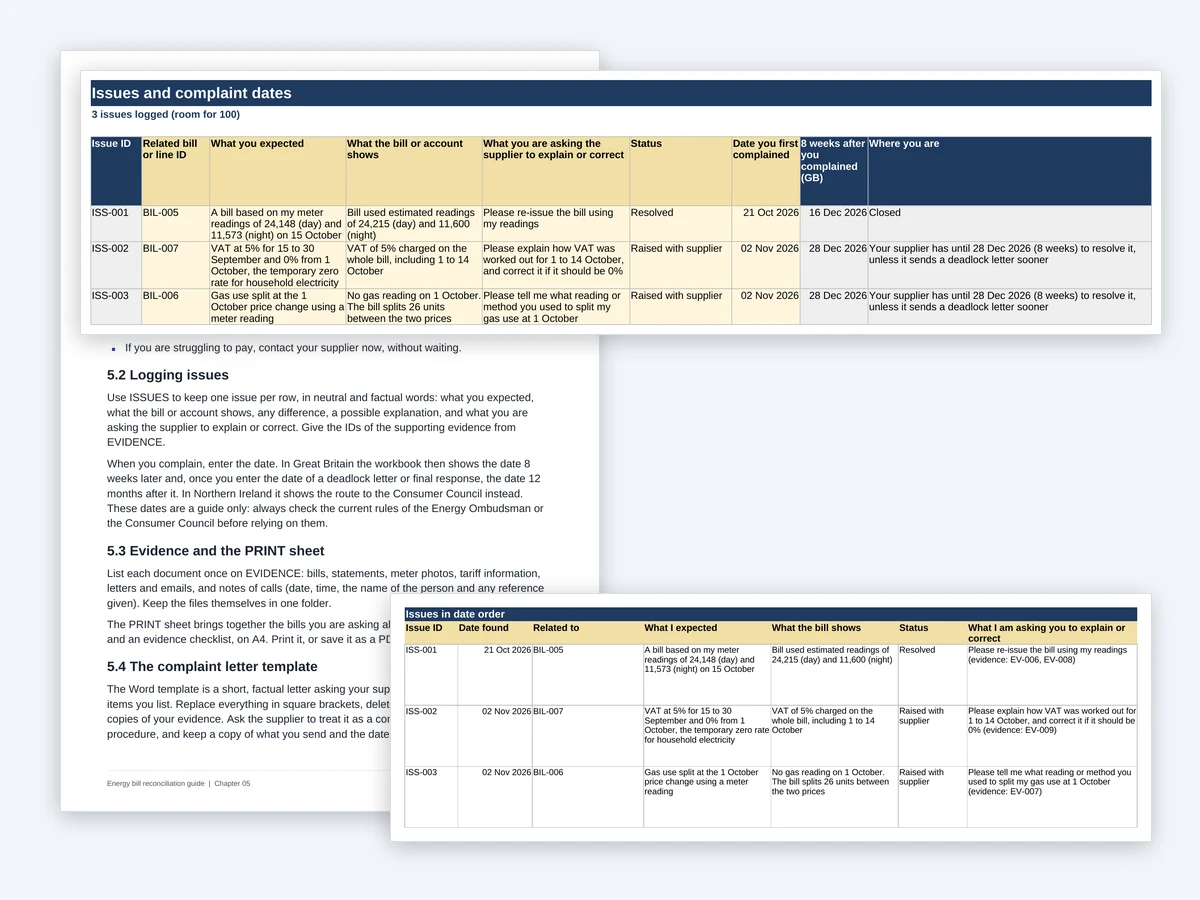
The ISSUES sheet with three fictional issues, their status and the date 8 weeks after the complaint, and the issues table on the PRINT sheet, in front of the guide's chapter on going from a discrepancy to a complaint

05

Issues, evidence and a summary to send

Log each issue in neutral, factual words: what you expected, what the bill shows and what you are asking the supplier to do. List your evidence once, from bills and statements to meter photos and notes of calls. In Great Britain the workbook shows the 8 week point after you complain, and in Northern Ireland the route to the Consumer Council. The PRINT sheet brings the bills, issues and an evidence checklist together on A4.

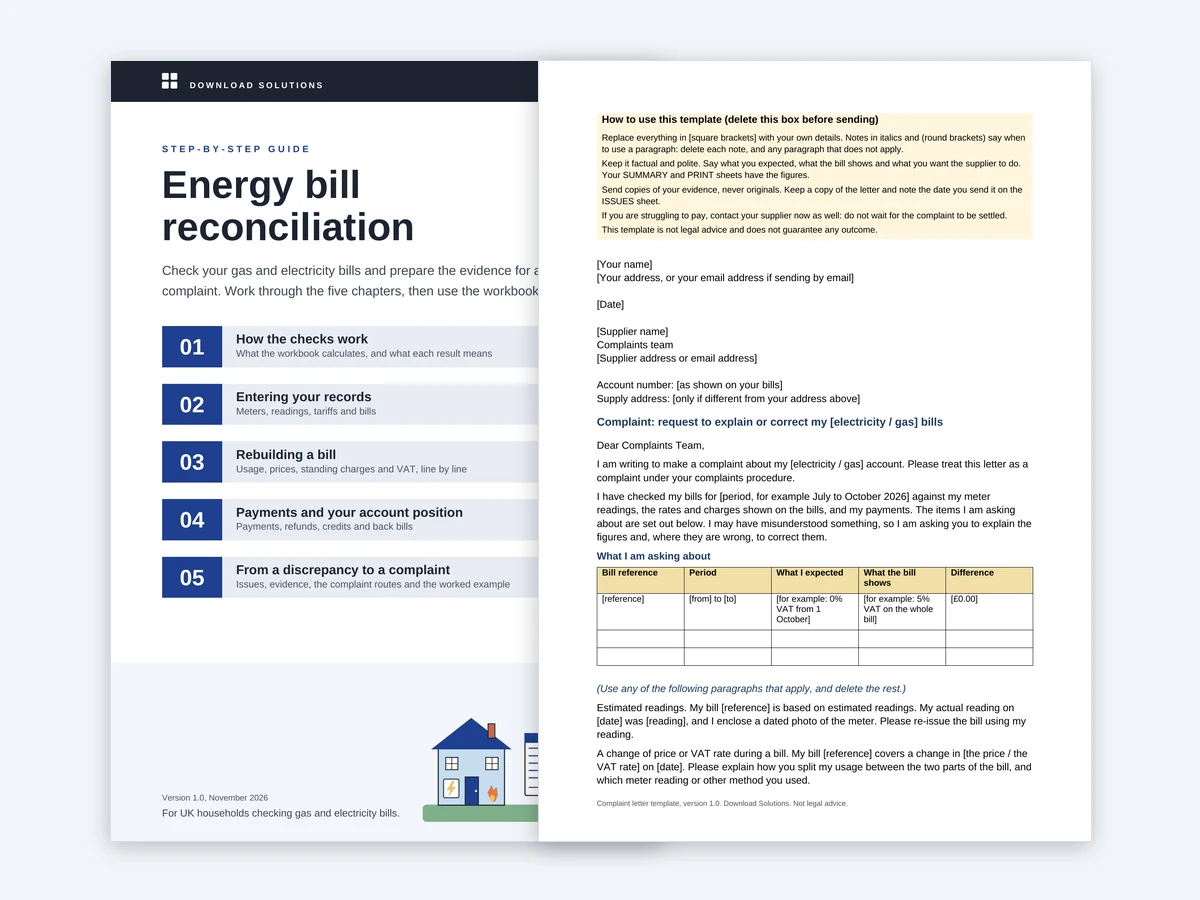
The guide cover listing its five chapters beside the first page of the complaint letter template, with fill-in fields in square brackets and a table of the items being queried

06

A plain-English guide, a worked example and a letter

The guide explains each check, how to copy figures from a bill, what each result means, the back-billing rules and the complaint routes in Great Britain and Northern Ireland, with a list of the official sources checked. A completed example for a fictional household shows every result worked through, and a Word letter template helps you ask your supplier to explain or correct the figures.

Is it right for you?

A good fit if

  • You pay a household gas or electricity bill in the UK and want to check the bills against your own readings and the prices shown on them.
  • You think a bill, an estimated reading, a price change or your account balance may be wrong, and want to set out the figures before you contact your supplier.
  • You are preparing a complaint and want your bills, readings, payments, evidence and complaint dates organised in one place.
  • You are on an ordinary single-rate or two-rate (such as Economy 7) tariff, with a metric or imperial gas meter.
  • You have Microsoft Excel and Word on a Windows computer and are comfortable copying figures from bills into cells.

Not the right choice if

  • You want someone to decide whether you have been overcharged, what you are owed or whether a rule applies to you. The workbook does the arithmetic on your entries; it does not make those decisions.
  • You are on a half-hourly, agile or other tariff whose price changes through the day, receive export payments (such as for solar), have a prepayment meter with debt being recovered, or are on a heat network. These are not calculated.
  • Your bills are for a business supply, or your meter has been exchanged, has gone round the clock or may be faulty.
  • You want a tool that contacts your supplier, connects to your account or reads your smart meter. It does none of these.
  • You will be using a Mac, Excel for the web, Google Sheets, Apple Numbers or LibreOffice. The files have only been tested in desktop Excel and Word for Windows.

What is in the download

Energy bill workbook (Excel)
A blank workbook for your own account, with sheets for your meters, readings, prices, bills, the bill check, payments, a summary, issues, evidence, a printable summary and the VAT rules. It has room for 150 bills and 300 readings.
Worked example (Excel)
The same workbook completed for a fictional household and supplier, with seven bills showing the main results. Its figures are a demonstration, not a typical result.
User guide (PDF)
A cover and 20 pages in five chapters, with a list of the official sources checked, for reading on screen or printing.
User guide (Word)
The same guide as an editable Word file, for your own notes.
Complaint letter template (Word)
A short, factual letter asking your supplier to explain or correct the items you list. You fill in the parts in square brackets and delete what does not apply.
START HERE (text file)
What to open first, where to get free help if you are struggling to pay, what is not calculated, and the version and date the sources were checked.

Microsoft Excel (.xlsx), Word (.docx), PDF. Tested in Microsoft 365 desktop Excel and Word (Version 2610) on Windows. Not tested on a Mac, in Excel for the web, Google Sheets, Apple Numbers or LibreOffice. No macros. Version 1.0, last updated 8 November 2026.
Before you buy: the limitations

  • It is a record-keeping and arithmetic tool, not legal or financial advice. It does not decide whether you have been overcharged, what you are owed, whether any rule applies or whether a complaint will succeed. It contacts no one and submits nothing to your supplier, Ofgem, the Energy Ombudsman, the Consumer Council or any other body, it is not approved by any of them, and you remain responsible for checking your entries against your own bills and statements.
  • Its results are only as good as what you enter. It cannot see your account, your meter or your supplier's systems, and a potential discrepancy may have an explanation it cannot see.
  • It does not calculate half-hourly, agile or other tariffs whose price changes through the day, export payments, prepayment debt recovery, heat networks, business supplies, exchanged or rolled-over meters, or suspected faulty meters. You can still log these as issues and keep the evidence.
  • Where a price or VAT rate changed during a bill and there is no reading on the day of the change, it shows UNDETERMINED rather than share the usage out by days.
  • It flags a bill covering energy used more than 12 months before the bill date for a possible back-billing review, and nothing more. Whether Ofgem's back-billing rules apply depends on facts it cannot know, and it never takes anything off a bill: see Ofgem's guidance on back bills.
  • VAT rates were checked on 3 November 2026 and rechecked on 8 November 2026. Household electricity in Great Britain is zero-rated in law from 1 October 2026 to 31 March 2027. HMRC's guidance says the government has announced an extension to 30 June 2027, but no law making that extension had been published when we checked, so the workbook marks it as announced, to be checked. Northern Ireland electricity and all household gas stay at the reduced rate of 5%. Check the current position in HMRC's VAT Notice 701/19.
  • The complaint dates it shows (8 weeks after you complain and 12 months after a deadlock letter, in Great Britain) are a guide only. Check the current rules of the Energy Ombudsman or, in Northern Ireland, the Consumer Council before relying on them.
  • You do not need this product to query a bill or complain. Your supplier's complaints process, the Energy Ombudsman and the Consumer Council for Northern Ireland are free to use, and Citizens Advice gives free help: see the Citizens Advice consumer service for energy problems. This product gives you a structured record and the arithmetic, not any access they do not have.
  • It has been tested in Microsoft 365 desktop Excel and Word (Version 2610) on Windows only. It has not been tested on a Mac, in Excel for the web, Google Sheets, Apple Numbers or LibreOffice, and some features, such as the drop-down lists and the protection that stops you typing over a calculation, may not work there.

Questions

Will it tell me if my supplier has overcharged me?

No. It rebuilds each bill from the figures on it and your readings, and shows Matches, Rounding difference, Potential discrepancy or UNDETERMINED. A potential discrepancy means the figures do not add up on what you have entered, so it is worth asking your supplier to explain. It is not proof of an error and it does not work out what you are owed.

What do I need before I start?

Your bills, ideally a statement of account from your supplier, and any photos of your meter. You copy the readings, unit rates, standing charges, VAT rate and totals from each bill, and your payments from your bank statement. The guide explains what to copy from each bill and where to enter it.

Can it check a bill where the price changed part way through?

Yes, if you have a meter reading from the day the price or VAT rate changed: you split the bill into two lines at that reading. If the bill shows your supplier's own split, you can enter its kWh for each part, and the line is labelled as the supplier's figure. Otherwise the line shows UNDETERMINED, because sharing your usage out by days would be a guess, and the guide explains how to ask your supplier how it split the usage.

Does it work for gas as well as electricity?

Yes. It converts gas meter readings into kWh using the volume correction and calorific value printed on your gas bill, for metric meters and older imperial meters. If the calorific value is missing, the line shows UNDETERMINED until you find it on the bill or ask your supplier.

Does it cover Northern Ireland?

Yes. You choose England, Wales, Scotland or Northern Ireland at the start. In Northern Ireland it uses the Northern Ireland VAT rates and shows the Consumer Council route for complaints instead of the Great Britain 8 week and Energy Ombudsman route, which does not apply there.

How does it help with a complaint?

It keeps each issue in neutral, factual words with the evidence that supports it, shows the key complaint dates, and gives you a printable summary of the bills and issues you are asking about. The Word template is a short letter asking your supplier to explain or correct those items. It does not send anything for you.

I am struggling to pay. Should I finish this first?

No. Contact your supplier now and ask about a payment plan and the help it offers customers in difficulty: you can still query a bill at the same time. Free advice is available from Citizens Advice (England and Wales), Advice Direct Scotland and the Consumer Council in Northern Ireland, and their numbers are in the guide and the START HERE file.

Will it run on a Mac or in Google Sheets?

It has not been tested there. It has been tested in Microsoft 365 desktop Excel and Word (Version 2610) on Windows only, and some features may not work elsewhere. The PDF guide opens in any ordinary PDF reader.

Buy once, keep the files

One-off payment. Ready to download straight away, with the link emailed to you.

£19.99

Buy and download