Estates and family affairs

UK Executor Estate Accounts & Administration Toolkit

Organise an estate's assets, debts, expenses and distributions, and prepare draft estate accounts, with a step-by-step guide, an Excel workbook and a worked example. For lay executors dealing with straightforward estates in England and Wales.

For customers in the UK only.

One-off payment. Instant download, with the link emailed to you. Digital product, nothing is posted.

Word (.docx), PDF, Microsoft Excel (.xlsx). The guide works on its own, on paper or on screen. The spreadsheets need Microsoft Excel. No macros. Read the limitations before you buy

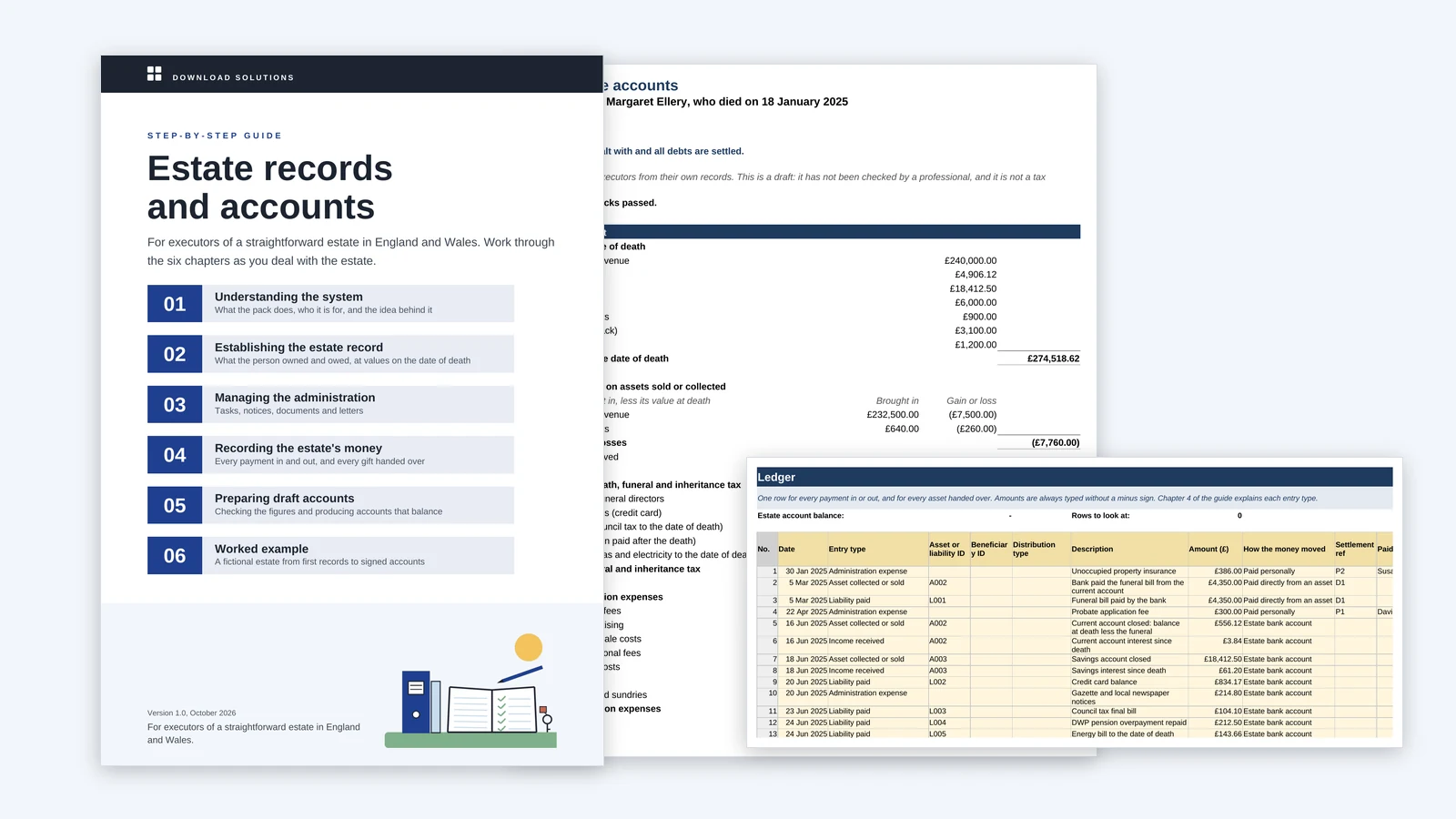
The guide's cover, page 1 of the worked example's draft estate accounts and the Ledger sheet of the Excel workbook

The problem

As an executor, you have to account for everything in the estate, often without ever having seen a set of estate accounts.

When someone dies, the executor collects in what they owned, pays what they owed and shares out the rest. Along the way come bank letters, valuations, bills, sale proceeds and payments to beneficiaries, often spread over a year or more. At the end, GOV.UK says the final estate accounts should be approved and signed by the executors and the main beneficiaries.

The hardest part is usually the arithmetic. It is easy to count the house twice, once at its value at death and again as the sale money, or to lose track of a funeral bill the bank paid directly, or a cost you paid yourself and need to reclaim. Home-made spreadsheets can be difficult to reconcile, especially when transactions are spread across several accounts and records.

This toolkit gives you a clear way to keep the records from the start, and a workbook that turns them into draft estate accounts and checks that the figures add up.

What it does for you

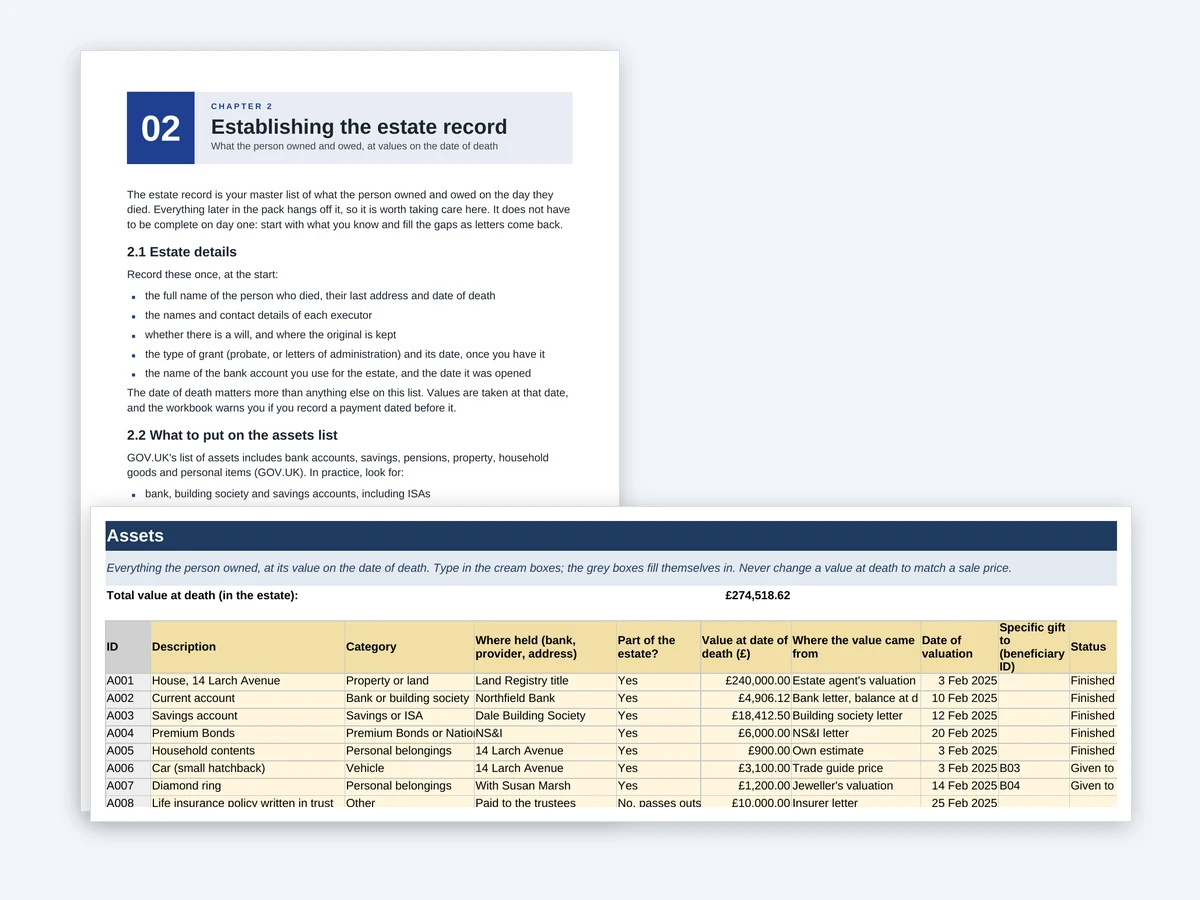
The Assets sheet of the worked example, listing a house, bank accounts, Premium Bonds and belongings at their values on the date of death, in front of the guide's chapter on the estate record

01

Everything the estate owned and owed, in one place

List each asset and debt at its value on the date of death, with where the value came from and the document behind it. Items that pass outside the estate, such as a policy written in trust, are recorded but kept out of the accounts.

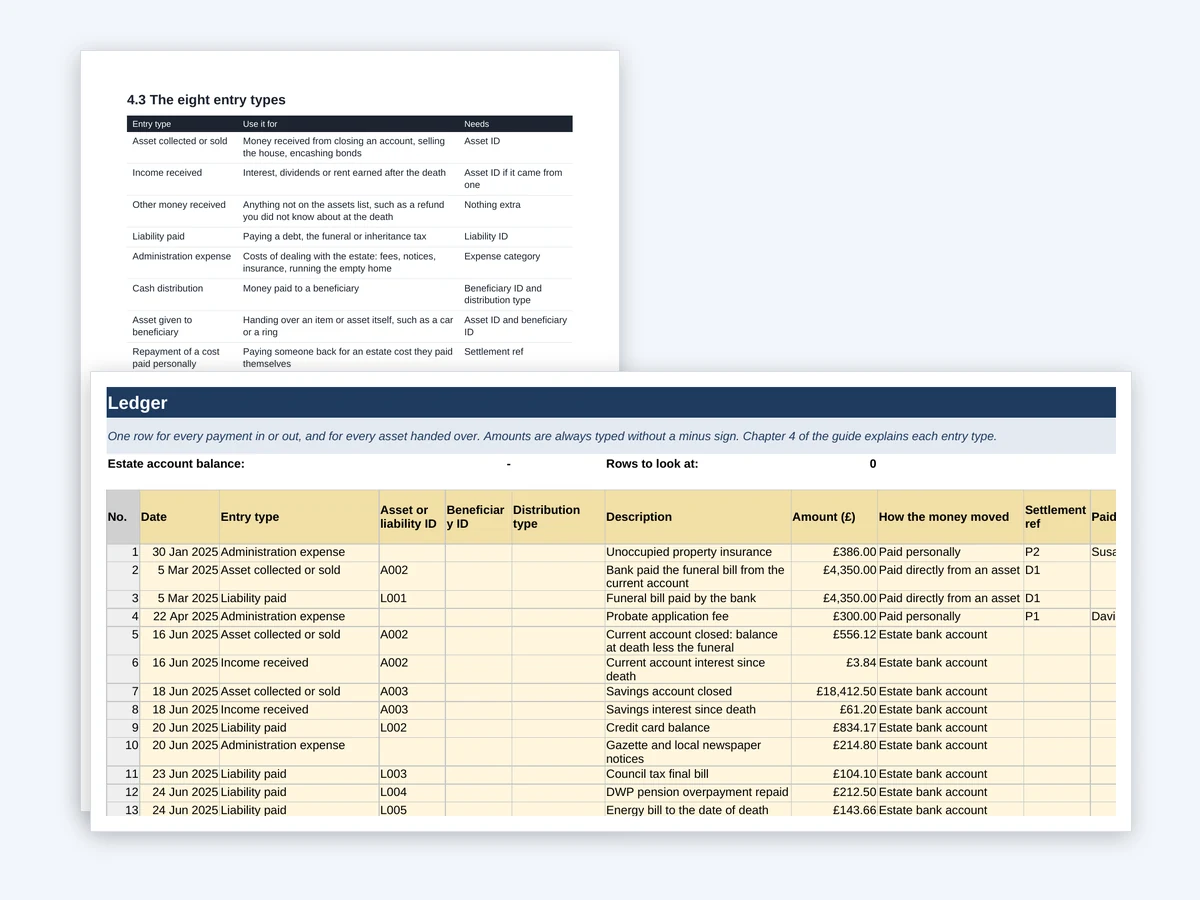
The Ledger sheet of the worked example, with dated payments in and out, each linked to an asset or debt, in front of the guide's table of the eight entry types

02

Every payment in and out, linked to what it relates to

One ledger row for each sale, closed account, bill, cost and payment to a beneficiary. It handles the awkward cases too: a funeral bill the bank paid straight from the account, and costs an executor paid personally and is repaid later.

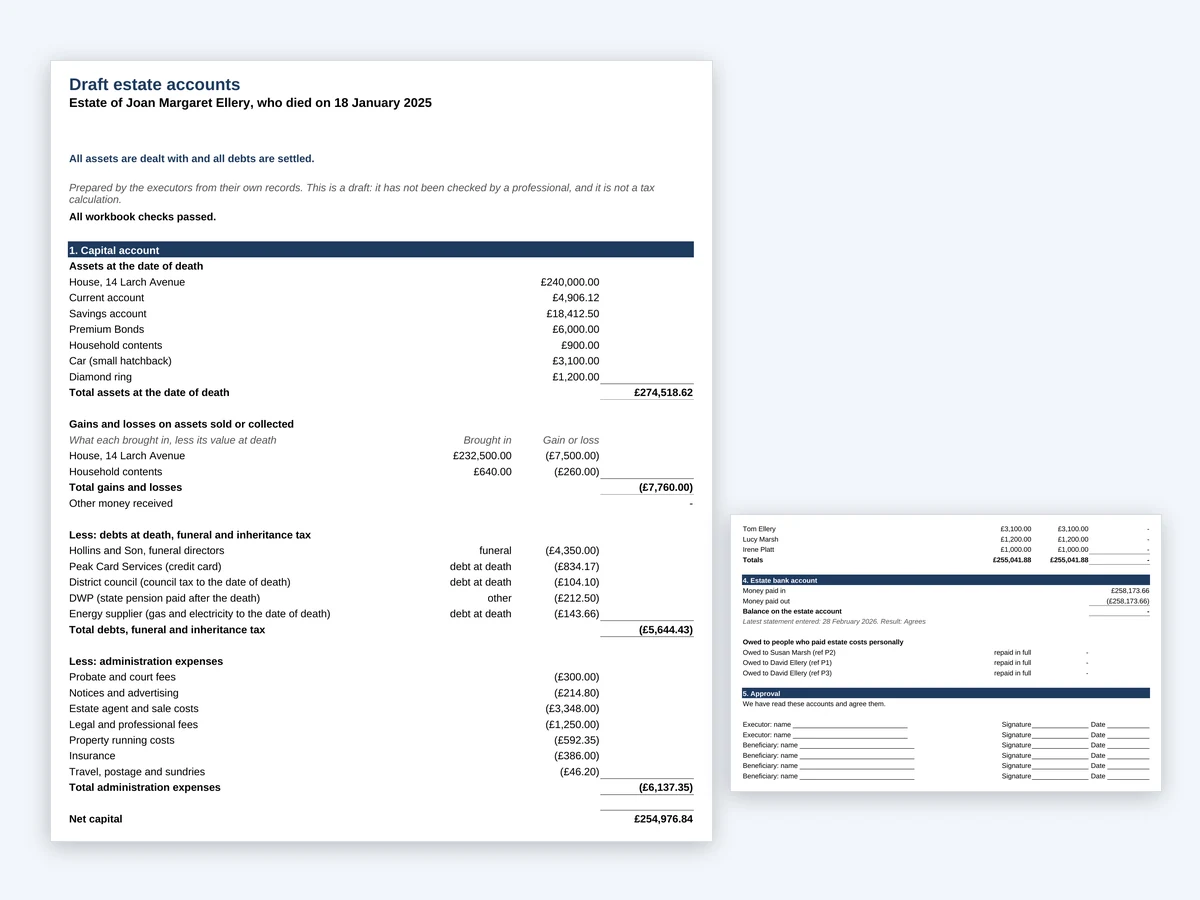
The capital account from the worked example's draft estate accounts, beside the estate bank account and the approval section with spaces for signatures

03

Draft estate accounts that build themselves

The workbook sets out the capital, income and distribution accounts, each beneficiary's position and the estate bank account, with space for signatures. It marks the accounts as provisional until every asset and debt is dealt with.

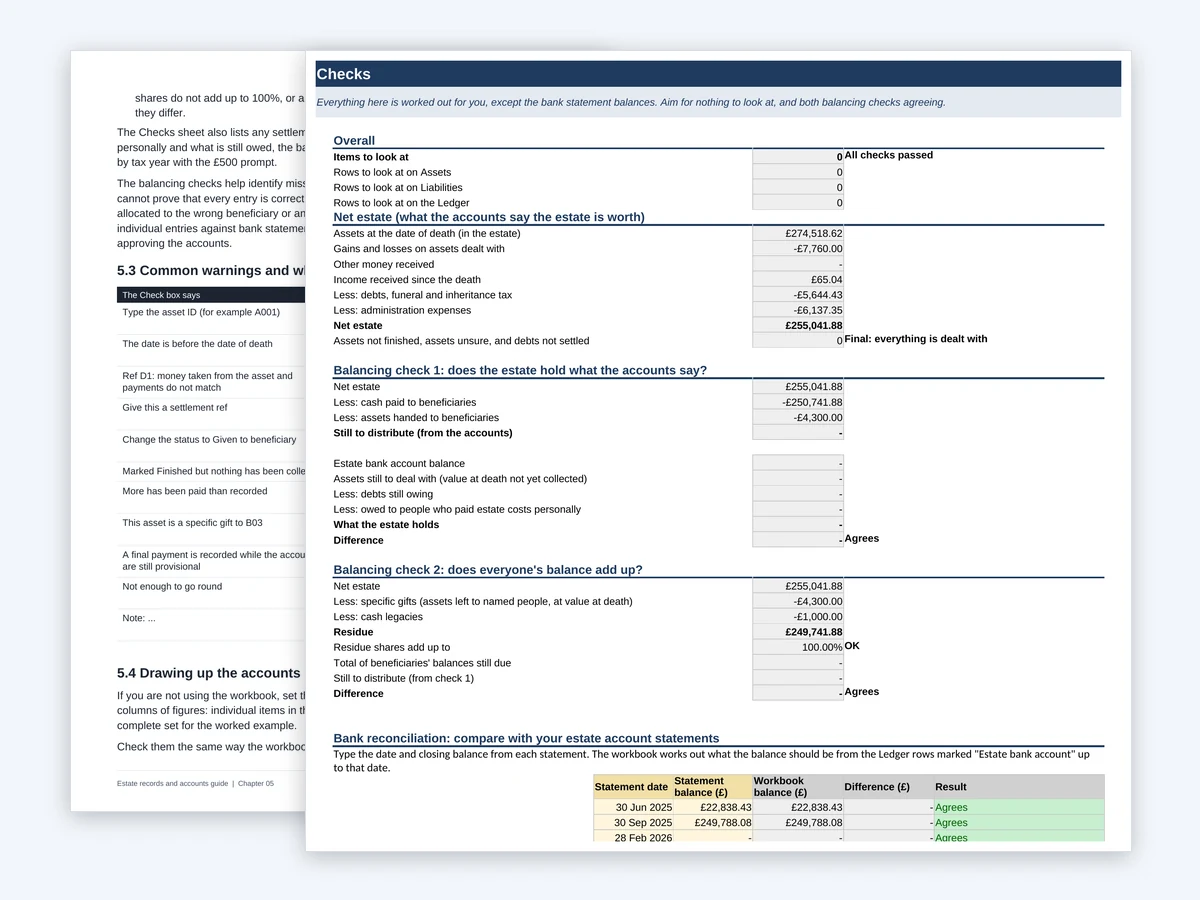
The Checks sheet of the worked example, with nothing to look at, both balancing checks agreeing and three bank statements agreeing, beside the guide's section on the checks

04

Checks that catch common mistakes

Two balancing checks, a bank statement comparison and plain-English warnings on every row help you find missing, duplicated or inconsistent entries early, before they reach the accounts. They cannot prove every entry is correct, so the guide shows you what to check by hand.

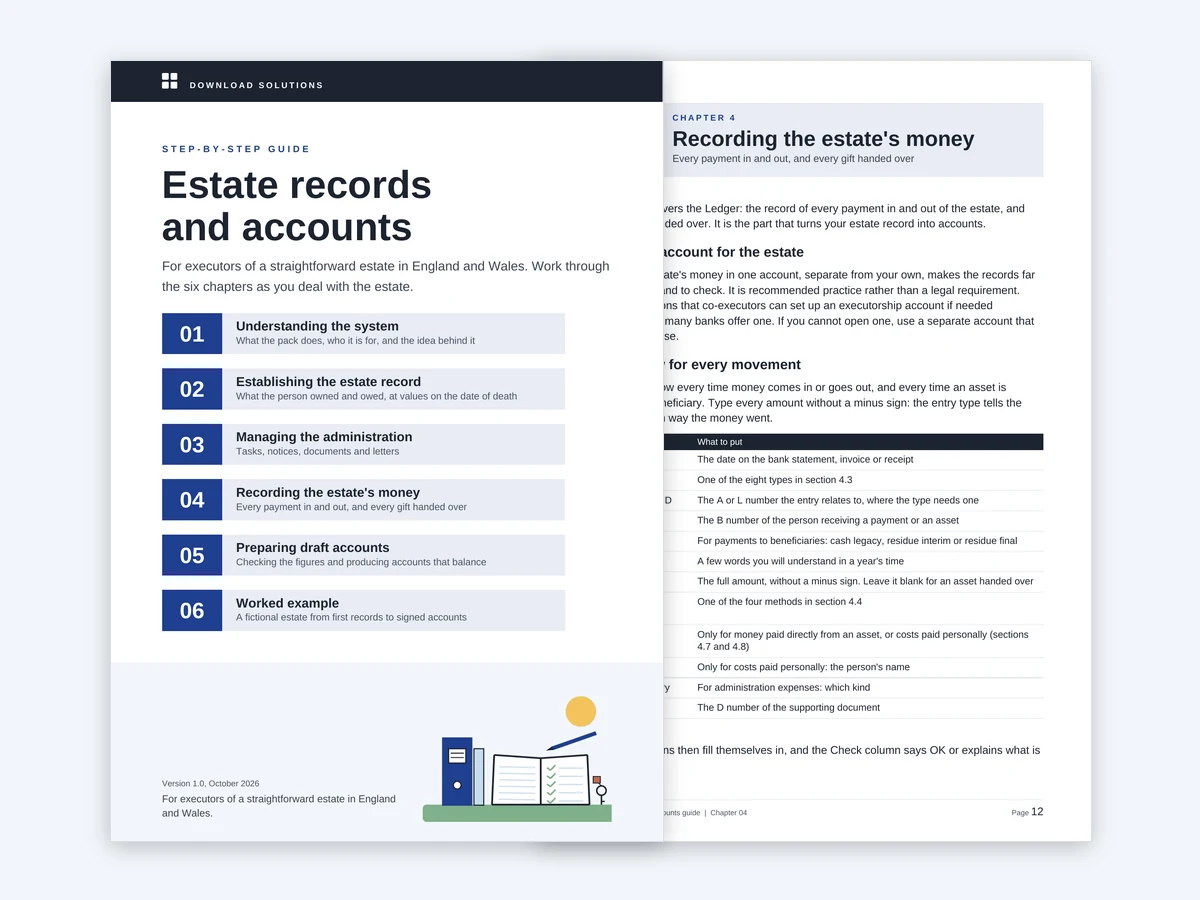
The guide's cover with its six chapters, and the opening page of chapter 4, Recording the estate's money

05

A step-by-step guide you can use on its own

Six chapters take you from the first records to signed accounts: what to record, a typical task list, notices for unknown creditors, how to record each kind of payment, and how to draw up the accounts by hand if you prefer paper.

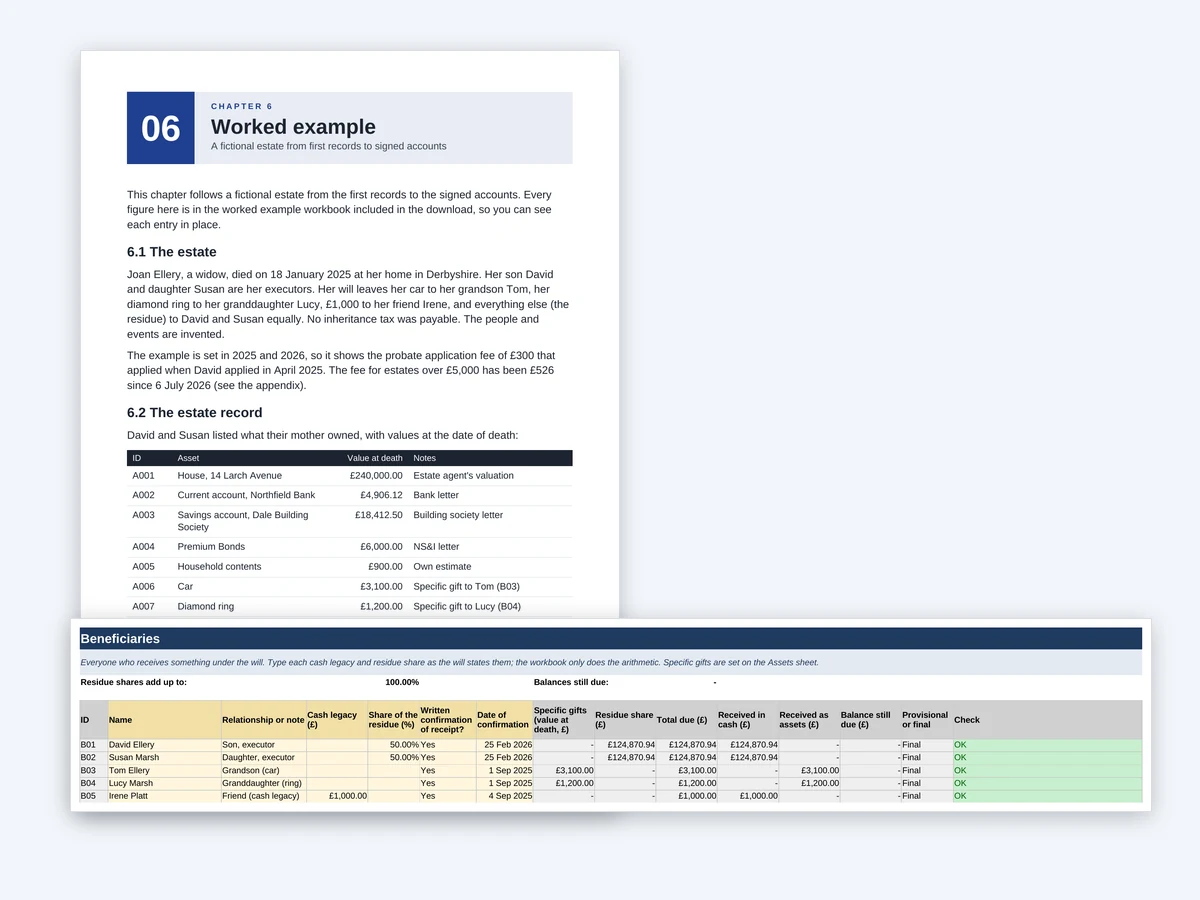
The Beneficiaries sheet of the worked example, showing each beneficiary's total due, the amount received and nothing left to pay, in front of the opening page of the guide's worked example chapter

06

A complete worked example

A fictional estate with a house sale, a funeral paid by the bank, interest, gifts of a car and a ring, a cash legacy and interim and final payments, followed from start to signed accounts. Open it alongside your own workbook to see how each entry is made.

Is it right for you?

A good fit if

  • You are an executor of a straightforward estate in England or Wales, dealing with it yourself.
  • The estate is mainly UK bank accounts and savings, perhaps a home, investments and belongings, with ordinary debts.
  • You want clear records from the start and draft accounts to share with the beneficiaries.
  • You are an administrator (there is no will) and already know who inherits and in what shares.

Not the right choice if

  • The will creates a trust, or gives someone a right to live in a property or an income for life.
  • The debts may be more than the estate is worth, or someone is disputing the will or making a claim.
  • The estate includes foreign assets, a business, a farm or agricultural land.
  • You need to work out who inherits without a will, or what inheritance tax or income tax is due.
  • The person lived, or the estate is being dealt with, in Scotland or Northern Ireland.

What is in the download

Executor estate accounts guide (Word)
The 25-page guide in six chapters, editable so you can add your own notes.
Executor estate accounts guide (PDF)
The same guide as a PDF, for reading on screen or printing.
Executor estate accounts workbook (Excel)
The blank workbook for your estate: assets, liabilities, ledger, beneficiaries, tasks, documents, checks and draft accounts.
Executor estate accounts worked example (Excel)
The same workbook filled in for a fictional estate, from first records to final accounts.

Word (.docx), PDF, Microsoft Excel (.xlsx). The guide works on its own, on paper or on screen. The spreadsheets need Microsoft Excel. No macros. Version 1.0, last updated 15 October 2026.
Before you buy: the limitations

  • This is a record-keeping and accounts preparation aid, not legal, tax or financial advice, and it is not produced or approved by HM Courts and Tribunals Service, HMRC or any government body. It does not submit anything to HMRC, the probate registry or any other authority, and you remain responsible for the accuracy of your records and accounts.
  • It is for straightforward estates in England and Wales only. It is not designed for trusts or life interests, insolvent estates, disputes or claims, foreign assets, businesses or farms, or estates in Scotland or Northern Ireland.
  • It does not interpret the will or work out who is entitled to what. You type in each cash legacy, gift and share of the residue as the will states them.
  • It does not calculate inheritance tax, income tax or capital gains tax. It flags estate income over £500 in a tax year as a prompt to check GOV.UK guidance, never as a tax decision.
  • It does not prepare a probate application or any legal document, and it does not decide whether the estate can be distributed.
  • The workbook's checks help find missing, duplicated or inconsistent entries, but they cannot prove that every entry is correct. You still need to check entries against bank statements, documents and the will.
  • The draft accounts are prepared from your own records. They are not a professional set of accounts and have not been checked by anyone else.
  • Official figures and rules in the guide were checked on 15 October 2026 and can change. The guide lists them with their sources so you can check them.
  • The spreadsheets need Microsoft Excel. They have not been tested in Google Sheets or Apple Numbers.

Questions

Do I need Excel to use it?

No. The guide works on its own, and chapter 5 shows how to draw up and check the accounts by hand. The spreadsheets need Microsoft Excel if you want the arithmetic and checks done for you.

Is this an official estate accounts template?

No. There is no single official format for estate accounts. The toolkit follows a common layout of capital, income and distribution accounts, and the guide explains each part so you can adapt it.

Can I use it if there is no will?

Yes, for the record-keeping and accounts, if you are the administrator and already know who inherits and in what shares. It does not work out the shares for you: you would need to find that out first, with advice if necessary.

When should I start using it?

As early as you can, ideally before money starts moving. You can also start part way through: record the values at death first, then enter the payments from your bank statements.

Does it help with probate or inheritance tax forms?

No. It keeps the values and documents you will need, but it does not fill in or submit any form. GOV.UK explains the probate and inheritance tax process.

Will it tell me if I have made a mistake?

It warns about many common mistakes, such as an entry dated before the death, a payment linked to nothing, or bank balances that do not match your statements. It cannot catch everything, such as a payment recorded against the wrong beneficiary, so you still need to check entries yourself.

Is my information sent anywhere?

No. The workbook is a file on your computer, and nothing you type in it is sent to Download Solutions or anyone else.

Buy once, keep the files

One-off payment. Ready to download straight away, with the link emailed to you.

£39.00

Buy and download