Consumer rights

Tenancy Deposit Dispute Aid

Get your evidence, dates and letters in order before you challenge deductions from a tenancy deposit in England or Wales. A step-by-step guide to the DPS, TDS and mydeposits dispute routes, an editable dispute workbook, four neutral letter and summary templates, a worked fictional case and a final checklist.

For customers in the UK only.

One-off payment. Instant download, with the link emailed to you. Digital product, nothing is posted.

Word (.docx), PDF. Tested in Microsoft Word (Microsoft 365) on Windows. Not tested on a Mac, a phone, a tablet or in Google Docs. No macros, formulas or add-ins. Read the limitations before you buy

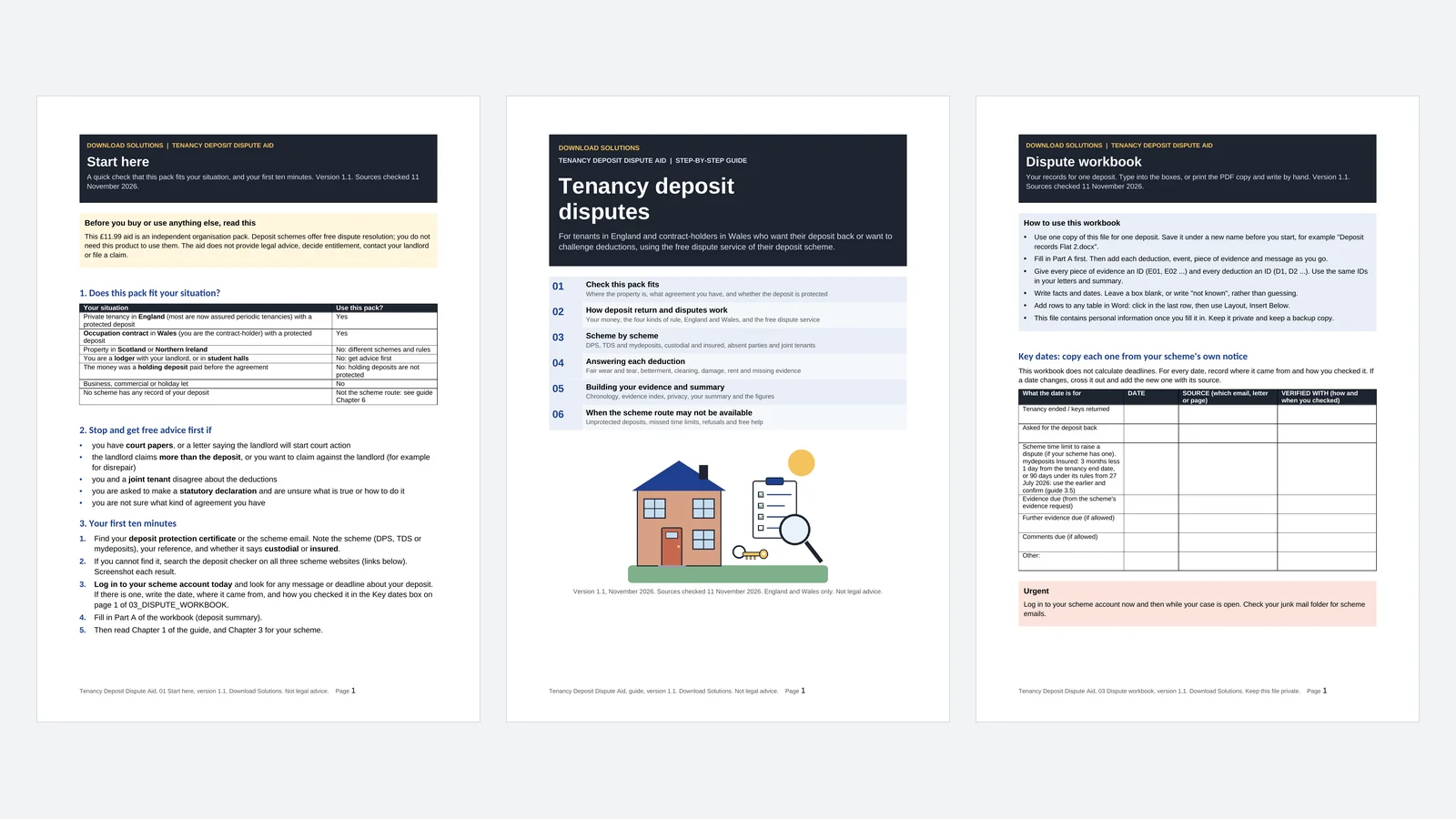
Three pages from the pack side by side: the Start here sheet, the cover of the guide listing its six chapters, and the first page of the dispute workbook with its key dates table

The problem

Disputing a deposit is free, but the evidence, the deadlines and the paperwork are left to you.

When a tenancy ends and the landlord or letting agent proposes deductions for cleaning, damage or rent, the scheme that protects your deposit offers a free dispute service. An adjudicator decides on the written evidence alone, with no hearing, so what you send and how clearly you set it out matters.

The steps and time limits differ between the Deposit Protection Service, the Tenancy Deposit Scheme and mydeposits, and between custodial and insured protection. Some periods run in calendar days and others in working days, and the rules in Wales use different words from those in England. It is easy to miss a step, send evidence that does not answer the claim, or lose track of who said what and when.

This pack helps you check that the scheme route fits your situation, answer each proposed deduction on its own facts, keep your dates, evidence and messages in one record, and assemble a clear summary for your scheme. It does not decide what you are entitled to, it submits nothing and it cannot promise any result. The schemes' dispute services are free, and you can use them without buying anything.

What it does for you

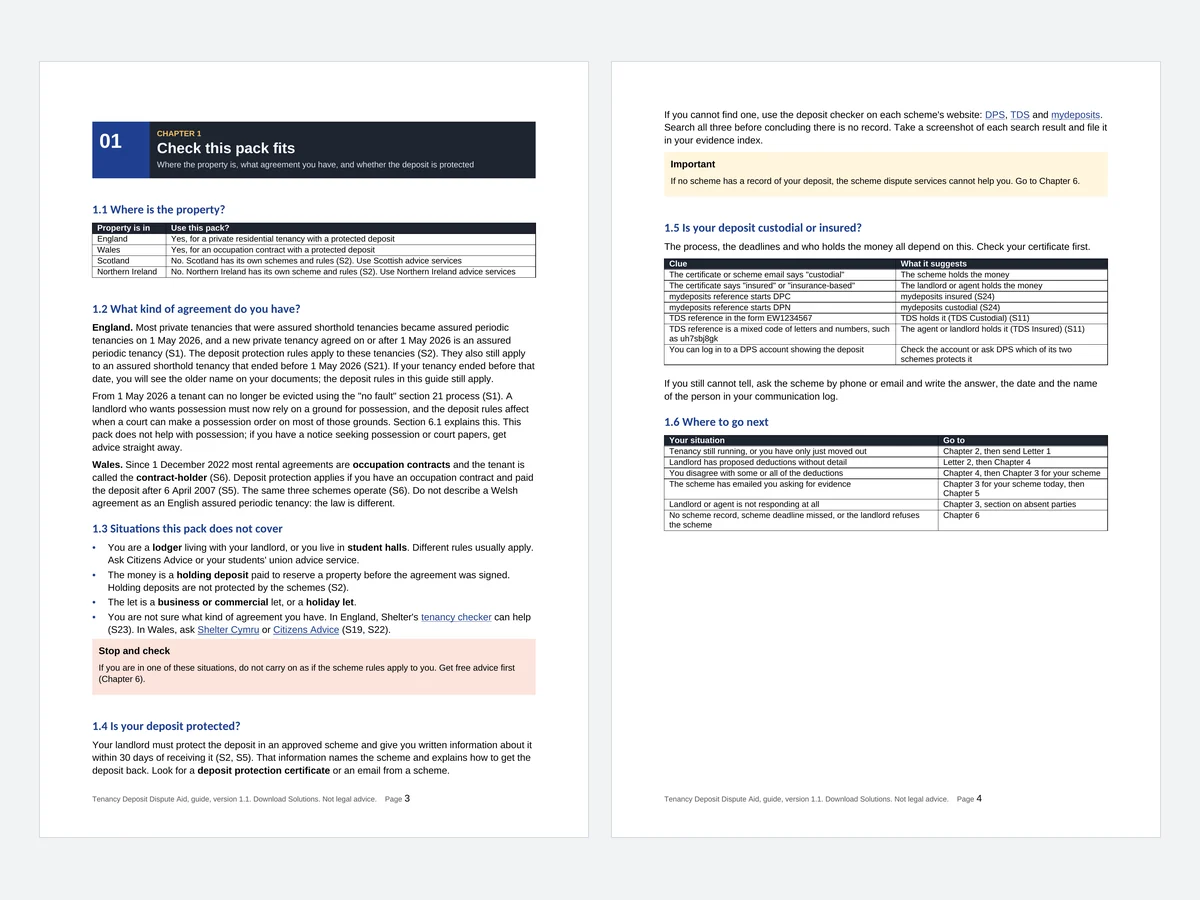
Two pages from chapter 1 of the guide: a table showing which countries the pack covers, the situations it does not cover, and a table of clues to whether a deposit is custodial or insured

01

Check the scheme route fits, and how your deposit is protected

A two page Start here sheet and the first chapter of the guide check that you are renting in England or Wales with a protected deposit, and tell you when to stop and get advice instead, such as when no scheme has a record of the deposit. They show you how to find out which of the three schemes holds it and whether it is custodial or insured, because the dispute steps depend on both.

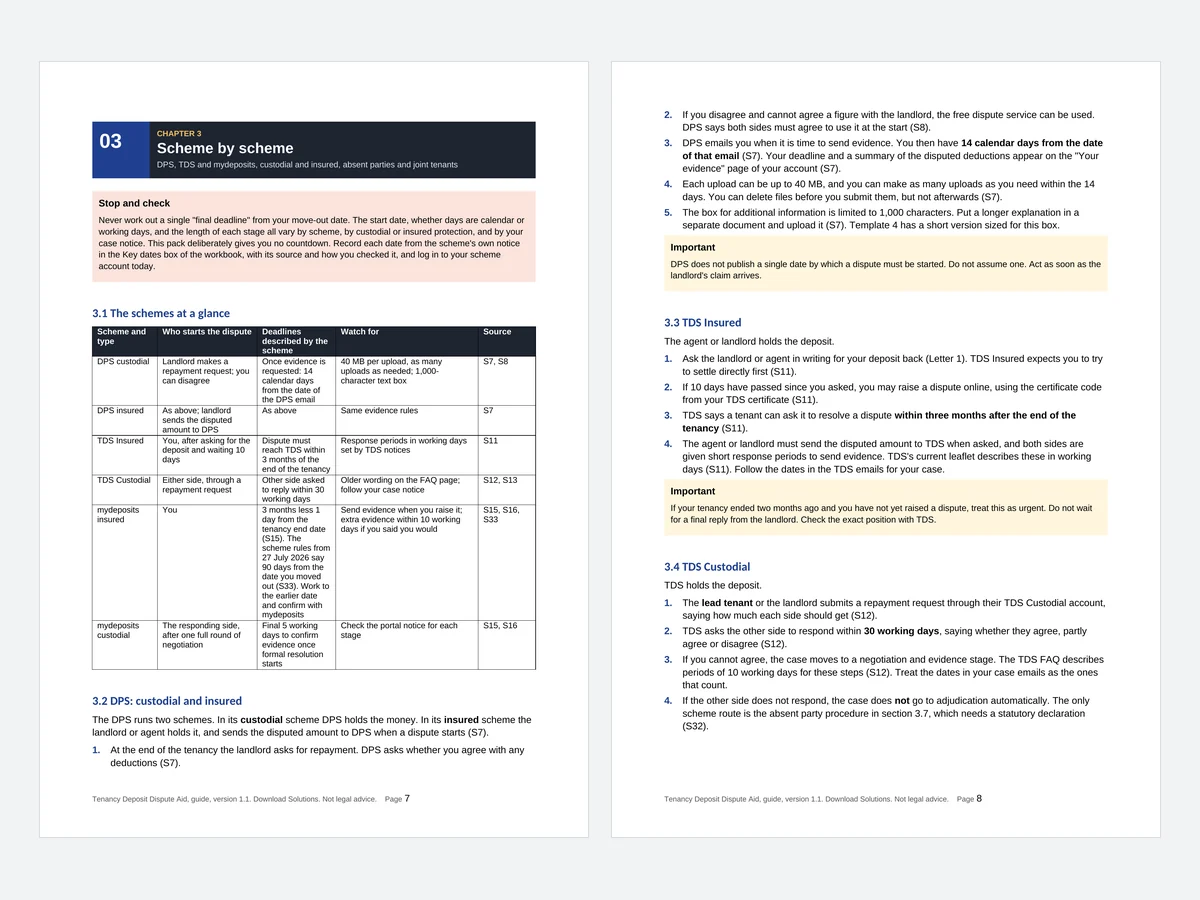
Two pages from chapter 3 of the guide: the schemes at a glance table with the source for each time limit, and the steps for DPS, TDS Insured and TDS Custodial

02

Each scheme's steps, without a made-up deadline

The guide sets out the dispute route for DPS, TDS and mydeposits, custodial and insured, as each scheme describes it, with the source for every time limit. It deliberately works out no countdown: you copy each date from your own scheme's notice into the workbook. Where a scheme's own sources disagree, as mydeposits' do on its insured time limit, the guide says so and tells you to work to the earlier date and confirm with the scheme.

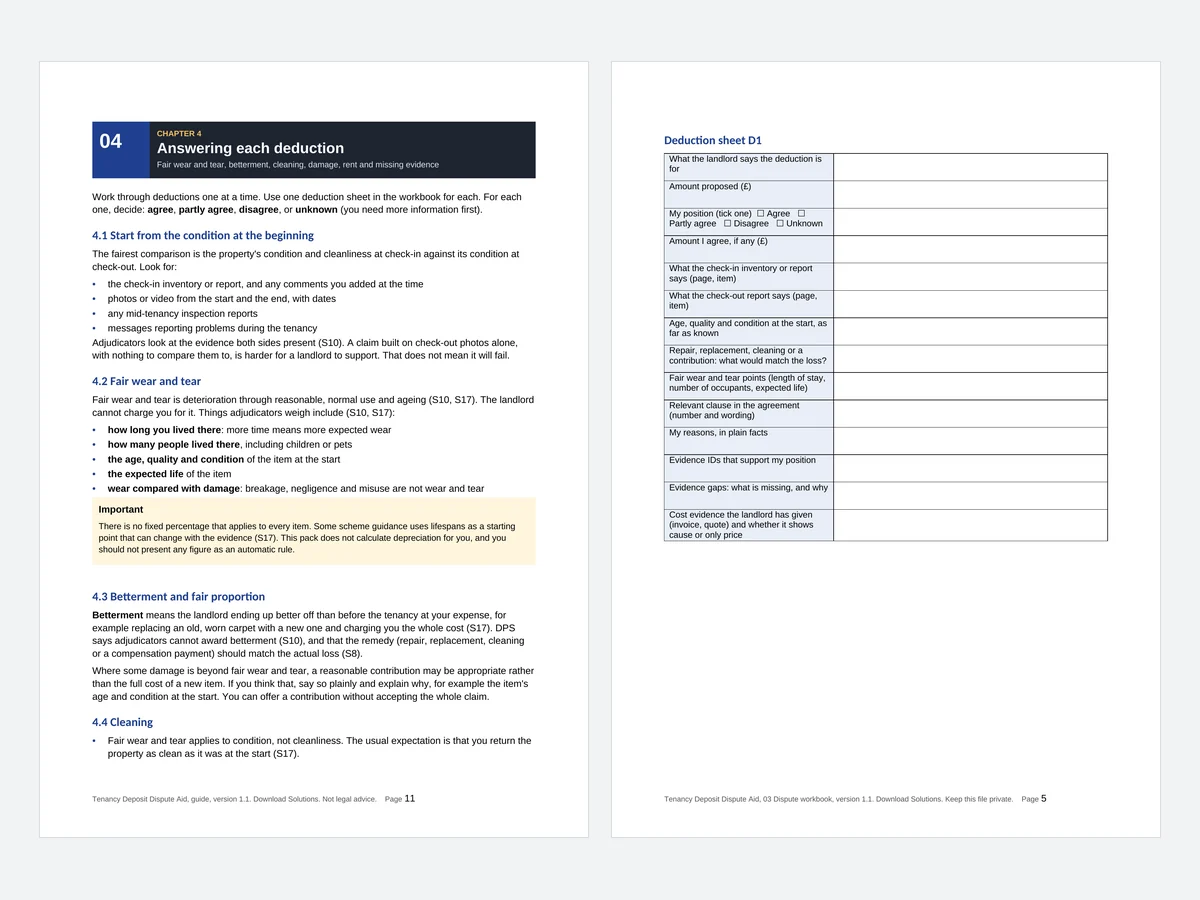
The start of chapter 4 of the guide on answering each deduction, beside a blank deduction sheet from the workbook with rows for the check-in and check-out records, fair wear and tear and evidence

03

Answer each deduction on its own facts

The guide explains what adjudicators weigh for cleaning, damage, redecoration, rent and missing items, including fair wear and tear and betterment, which is the landlord ending up better off at your expense. A deduction sheet for each item helps you compare the check-in and check-out records and decide whether you agree, partly agree, disagree or need more information. The pack calculates no depreciation and gives no fixed percentages.

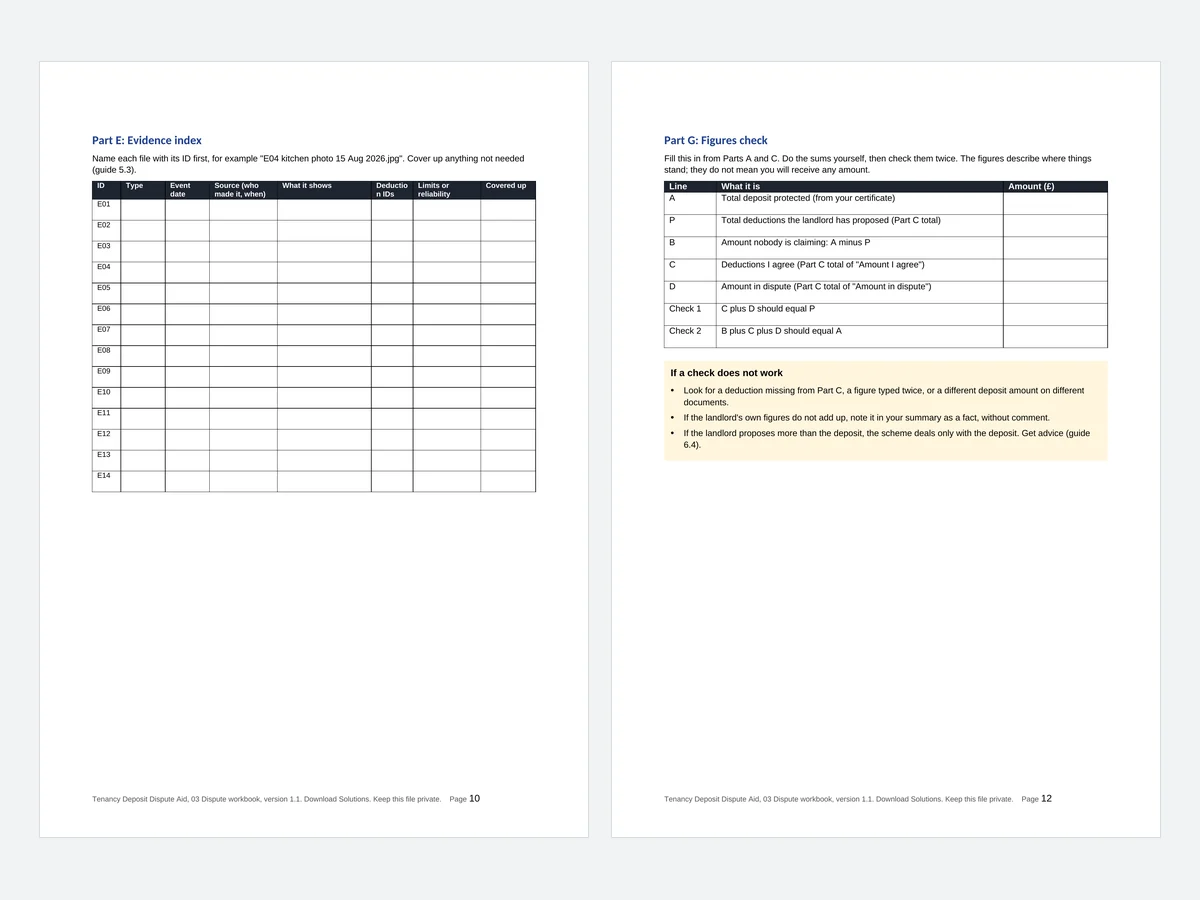
Two blank pages from the dispute workbook: the evidence index with numbered rows E01 to E14, and the figures check with lines A, P, B, C and D and two checks

04

One record for your dates, evidence and figures

The editable workbook keeps a key dates table with the source of each date and how you checked it, a deduction register, a chronology, a numbered evidence index, a communication log and a figures check. The figures check makes sure the deposit equals the amount nobody is claiming, plus what you agree, plus what is in dispute, so your summary does not contradict itself.

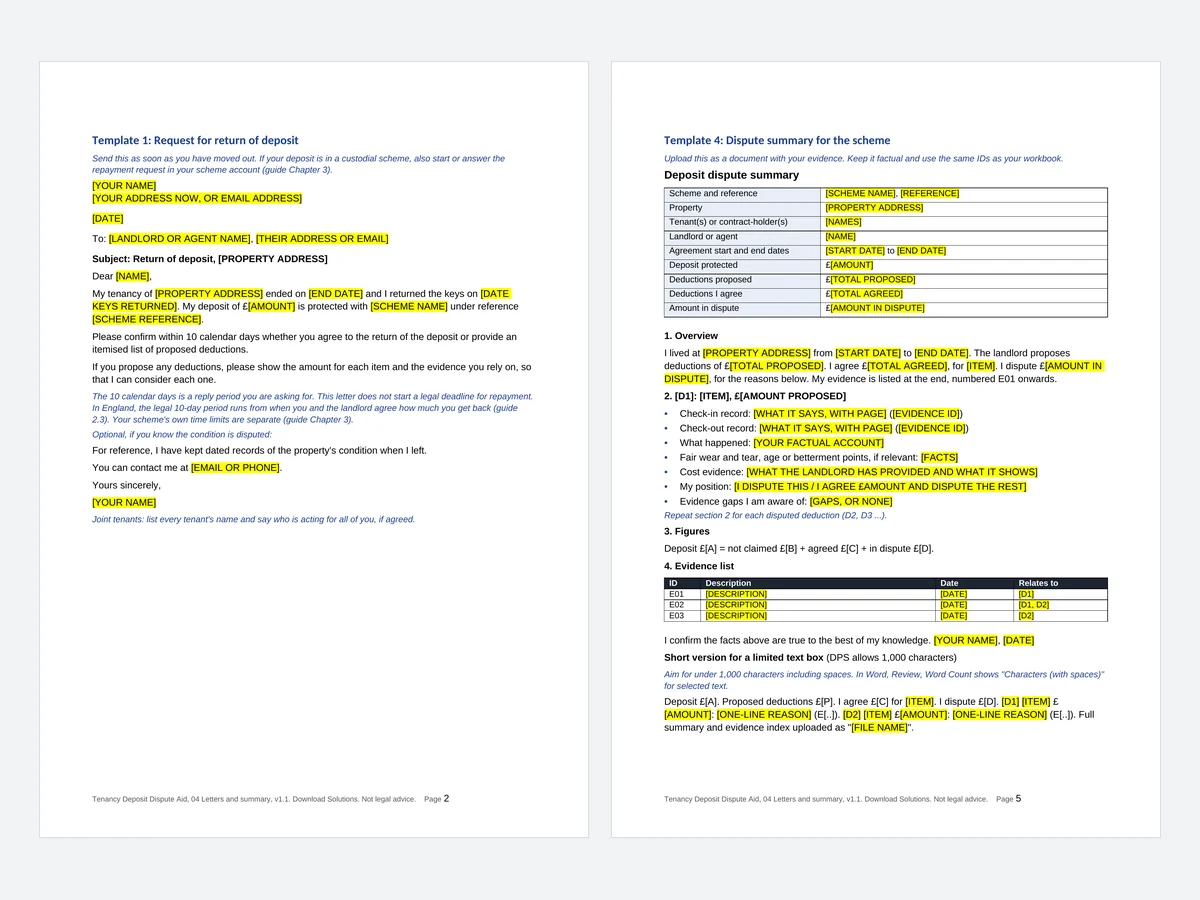
Two pages from the letters and summary file: template 1 asking for the deposit back with highlighted placeholders, and template 4, the dispute summary for the scheme

05

Four neutral templates, from first request to dispute summary

Editable templates help you ask for your deposit back, ask for an itemised list of deductions and the evidence behind them, answer each deduction, and set out a dispute summary for your scheme, with a short version sized for a 1,000 character text box. The first letter asks for a reply within 10 calendar days and explains that this is a period you are asking for, not a legal deadline. Every placeholder is highlighted, and none of the wording threatens or exaggerates.

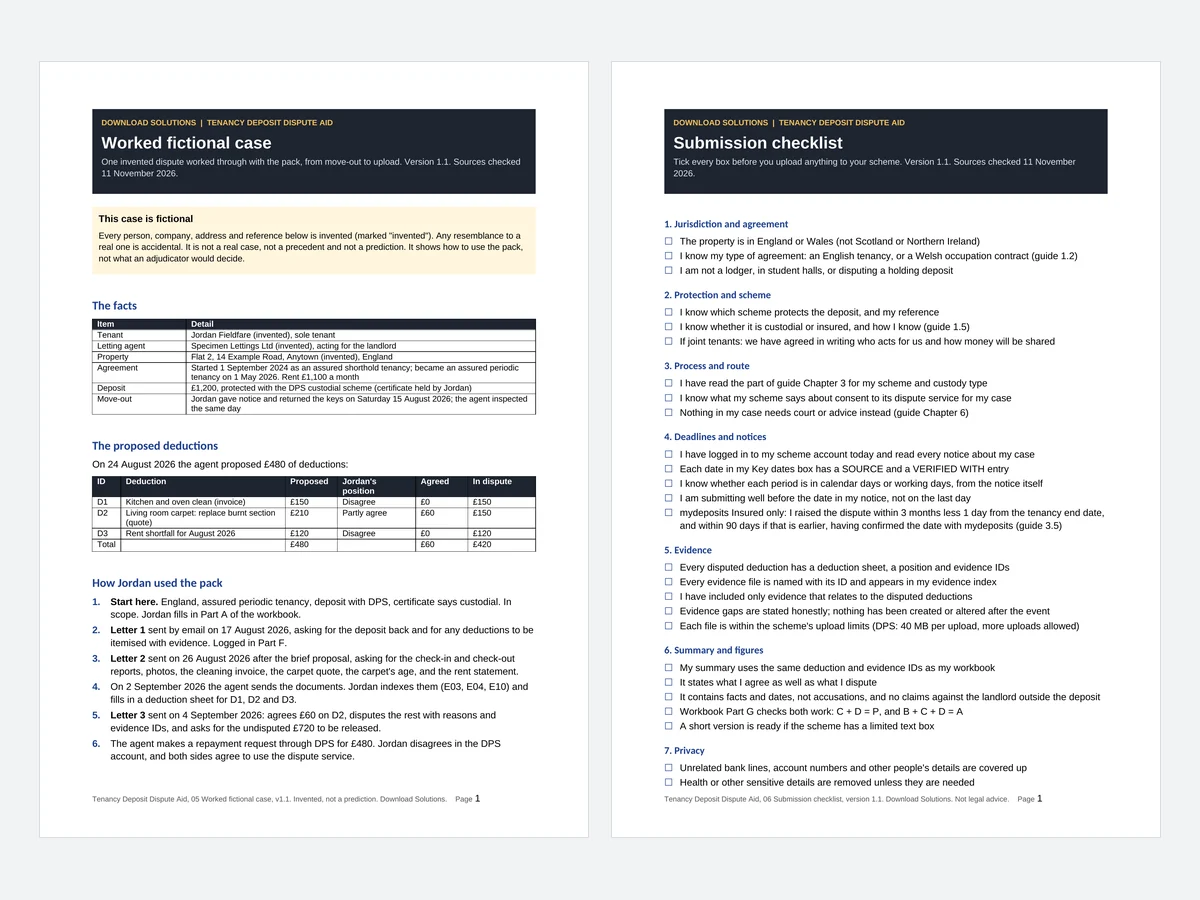
The first page of the worked fictional case, headed as fictional with the facts set out in a table, beside the first page of the submission checklist

06

A worked fictional case and a final checklist

An invented case shows the pack in use from move-out to upload: a £1,200 deposit, £480 of proposed deductions, £60 agreed and £420 disputed, with evidence gaps stated honestly. It stops at upload and does not show or predict any outcome. A submission checklist then takes you through scheme, dates, evidence, figures and privacy before you send anything.

Is it right for you?

A good fit if

  • You rented privately in England, or had an occupation contract in Wales, and your deposit is protected with the DPS, TDS or mydeposits.
  • Your landlord or letting agent has proposed deductions you disagree with, in full or in part, or has not yet said what they want to keep.
  • You want to set out your evidence, dates and figures clearly before you raise a dispute or answer the scheme's request for evidence.
  • You would like neutral, editable wording for asking for your deposit, asking for evidence and answering each deduction, rather than starting from a blank page.
  • You use Microsoft Word on a Windows computer and are comfortable editing letters and typing into tables.

Not the right choice if

  • You want someone to tell you whether a deduction is fair, how much you will get back or whether your evidence is enough. The pack cannot, and nothing can promise a result.
  • The property is in Scotland or Northern Ireland, you are a lodger or live in student halls, the money was a holding deposit, or the let was a business or holiday let.
  • No scheme has a record of your deposit, or you want compensation from the landlord for not protecting it. That is a court route, and the pack points you to free advice instead.
  • You have court papers, a notice seeking possession, or a dispute about more than the deposit, such as disrepair or a claim larger than the deposit. Get advice first.
  • You will be using a Mac, a phone, a tablet or Google Docs. The Word files have only been tested in Microsoft Word on Windows.

What is in the download

Start here (PDF)
Two pages to read first: whether the pack fits your situation, when to stop and get free advice, your first ten minutes and the free official routes.
Tenancy deposit guide (Word and PDF)
Nineteen pages in six chapters: checking the pack fits, how deposit return and disputes work in England and Wales, each scheme's steps, answering each deduction, building your evidence and summary, and what to do when the scheme route is not available, with a dated list of sources.
Dispute workbook (Word, with a PDF print copy)
Key dates with their sources, a deposit summary, procedural checkpoints, a deduction register and four deduction sheets, a chronology, an evidence index, a communication log and a figures check.
Letters and summary templates (Word and PDF)
Four editable templates: request for return of the deposit, request for itemised deductions and evidence, response to proposed deductions, and a dispute summary for the scheme.
Worked fictional case (PDF)
Three pages showing one invented dispute worked through with the pack, from move-out to upload.
Submission checklist (PDF)
Two pages of final checks before you upload anything to your scheme.
Sources and changelog (PDF)
The sources the pack relies on and the date each was checked, the known limitations, the version history and when the pack will be reviewed.

Word (.docx), PDF. Tested in Microsoft Word (Microsoft 365) on Windows. Not tested on a Mac, a phone, a tablet or in Google Docs. No macros, formulas or add-ins. Version 1.1, last updated 11 November 2026.
Before you buy: the limitations

  • It is a preparation and record-keeping pack, not legal advice. It does not decide whether a deduction is fair, what you are entitled to or whether your evidence is enough, and it cannot promise any result. It does not contact your landlord or letting agent and submits nothing to any deposit scheme, court or other body, none of them produced, endorsed or approved it, and you remain responsible for the accuracy of everything you send and for meeting the dates in your own scheme's notices.
  • It covers private tenancies in England and occupation contracts in Wales, with a deposit protected by the Deposit Protection Service, the Tenancy Deposit Scheme or mydeposits. It does not cover Scotland, Northern Ireland, lodgers, student halls, holding deposits or business and holiday lets.
  • It does not work out deadlines. Each scheme sets its own steps and time limits, and some are counted in calendar days and others in working days, so you copy every date from your own scheme's notice or website on the day you check.
  • The sources were checked on 11 November 2026, and the pack gives the date each was checked. mydeposits' tenant guidance gives its insured time limit as 3 months less 1 day from the tenancy end date, while its insured scheme rules in force from 27 July 2026 give 90 days. The pack tells you to work to the earlier date and to confirm the date for your case with mydeposits.
  • It does not prepare court claims, compensation claims for an unprotected deposit or anything to do with possession or eviction, and it tells you to get free advice if you have court papers or a notice seeking possession.
  • You do not need this pack to dispute a deposit. Each scheme's dispute service is free for tenants, and free advice is available from Citizens Advice and Shelter in England and from Citizens Advice and Shelter Cymru in Wales: see Citizens Advice's guidance on getting your tenancy deposit back. This pack helps you prepare, and gives you no special access or priority with any scheme.
  • It was tested in Microsoft Word (Microsoft 365) on Windows. The files have not been tested on a Mac, a phone, a tablet or in Google Docs, so they may not look or work the same there. The pack does not send your information anywhere: what you type stays in the files on your own computer unless you choose to share them, and we do not want your tenancy documents, personal details or evidence.

Questions

Do I need this pack to dispute my deposit?

No. The Deposit Protection Service, the Tenancy Deposit Scheme and mydeposits each run a free dispute service, and free advice is available from Citizens Advice, Shelter and Shelter Cymru. The pack is for people who want their evidence, dates and letters organised before they use that free service, and it gives you no special access or priority.

Will it tell me how much of my deposit I will get back?

No. It helps you answer each proposed deduction with facts and evidence and check that your figures add up. The adjudicator decides on the evidence from both sides, and nothing in the pack can predict or promise a result.

Which deposit schemes does it cover?

All three schemes in England and Wales: the Deposit Protection Service, the Tenancy Deposit Scheme and mydeposits, with their custodial and insured versions described separately. The guide shows you how to find out which scheme and which type holds your deposit.

How long do I have to raise a dispute?

It depends on the scheme and on whether your deposit is custodial or insured. TDS Insured, for example, says a tenant can ask it to resolve a dispute within three months of the end of the tenancy, while other stages run in working days set by the scheme's notices. The pack does not work out a date for you: check your scheme account and its notices now, and act early rather than wait.

Does it work for Wales?

Yes, for occupation contracts in Wales, where the tenant is called the contract-holder. The same three schemes operate there, and the guide notes where the Welsh rules and terms differ from England's.

Does it submit the dispute for me?

No. You raise the dispute and upload your evidence yourself, on your scheme's website and by the dates in its notices. The templates are not official scheme forms.

My deposit was never protected. Can this pack help?

Only to point you in the right direction. If no scheme has a record of your deposit, the scheme dispute services cannot help, and the route is through the court. The pack does not prepare court or compensation claims, so get free advice from Citizens Advice, Shelter or Shelter Cymru.

Will it run on a Mac or in Google Docs?

It has not been tested there. The Word files were tested in Microsoft Word (Microsoft 365) on Windows, so they may not look or work the same elsewhere. The PDFs open in any ordinary PDF reader.

Buy once, keep the files

One-off payment. Ready to download straight away, with the link emailed to you.

£11.99

Buy and download