Consumer rights

Motor Insurance Dispute

Disagree with your motor insurer about a write-off valuation, a refused claim, repairs or a deduction, an excess, a delay or a complaint? Find your starting point, gather your evidence, record what happened and prepare your own letters. Four PDFs, three editable Word files and seven templates.

For customers in the UK only.

One-off payment. Instant download, with the link emailed to you. Digital product, nothing is posted.

PDF, Word (.docx). Word files tested in Microsoft Word (Microsoft 365) on Windows. PDF files tested in Microsoft Edge on Windows. Not tested on a Mac, a phone or tablet, in Google Docs, in LibreOffice or with screen-reading software. No macros. Read the limitations before you buy

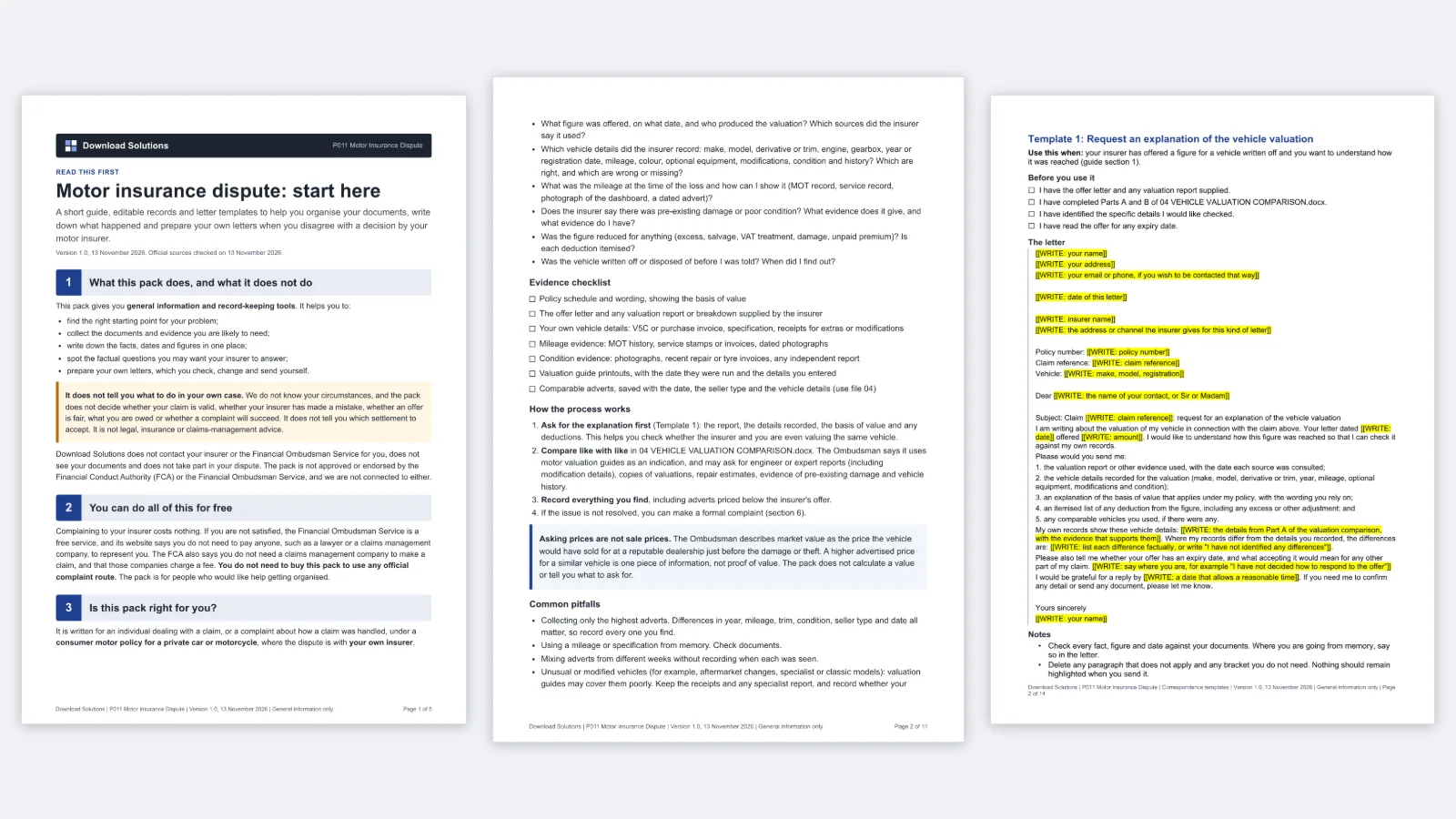
Three pages from the pack side by side: the first page of the Start here guide, a page of the guide on a disputed valuation with its evidence checklist, and the first letter template with its yellow placeholders

The problem

A disagreement with your motor insurer comes with documents, dates and decisions that are hard to keep track of.

A write-off offer that seems low, a claim refused, a repair you are unhappy with, an excess that does not match your policy, or weeks of waiting with no update: motor insurance disagreements start in different places, but they often leave you with the same mess. Letters and emails from different dates, photographs, estimates, call notes and a policy wording you have not read closely in years.

The practical difficulty is knowing what to gather, what to write down and what to ask. Which figure was offered, and on which vehicle details? Which clause is the insurer relying on? When did you complain, and what date is on the final response? Without a clear record, it is hard to write a calm, specific letter, and easy to lose track of a date.

This pack helps you choose a starting point, collect your evidence, record the facts, compare a valuation with your own vehicle details and draft your own letters. It does not tell you whether your insurer is right, whether an offer is fair or what to accept. Complaining to your insurer, and then to the Financial Ombudsman Service, is free, and you do not need this pack to do either.

What it does for you

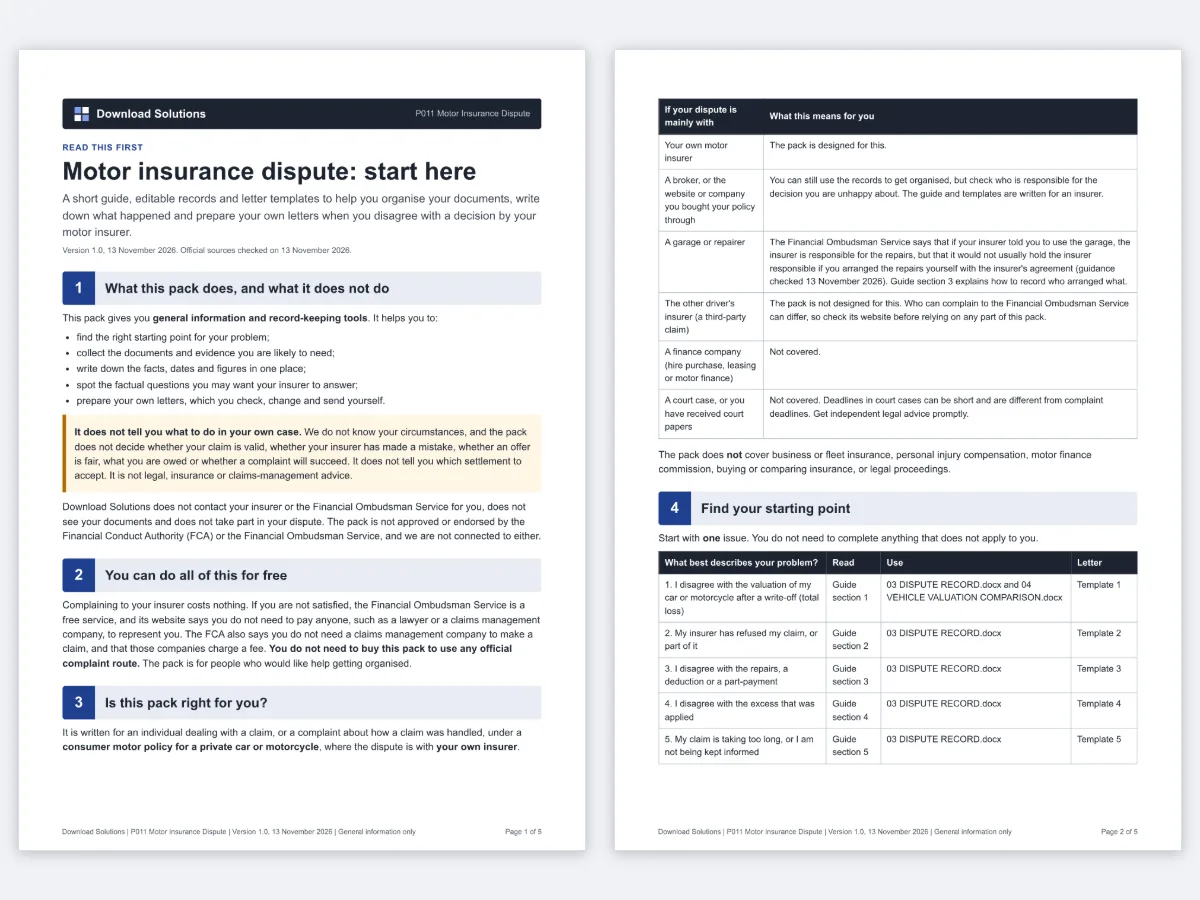
The first two pages of the Start here guide: what the pack does and does not do, and the table that matches six common problems to a guide section, a file and a letter template

01

Find your starting point, and the dates to check

A five page Start here guide explains what the pack does and does not do, helps you pick the issue that fits, lists the documents to gather and sets out eight steps. It tells you plainly that using the pack does not pause any deadline, and that you can complain to your insurer and then to the Financial Ombudsman Service for free.

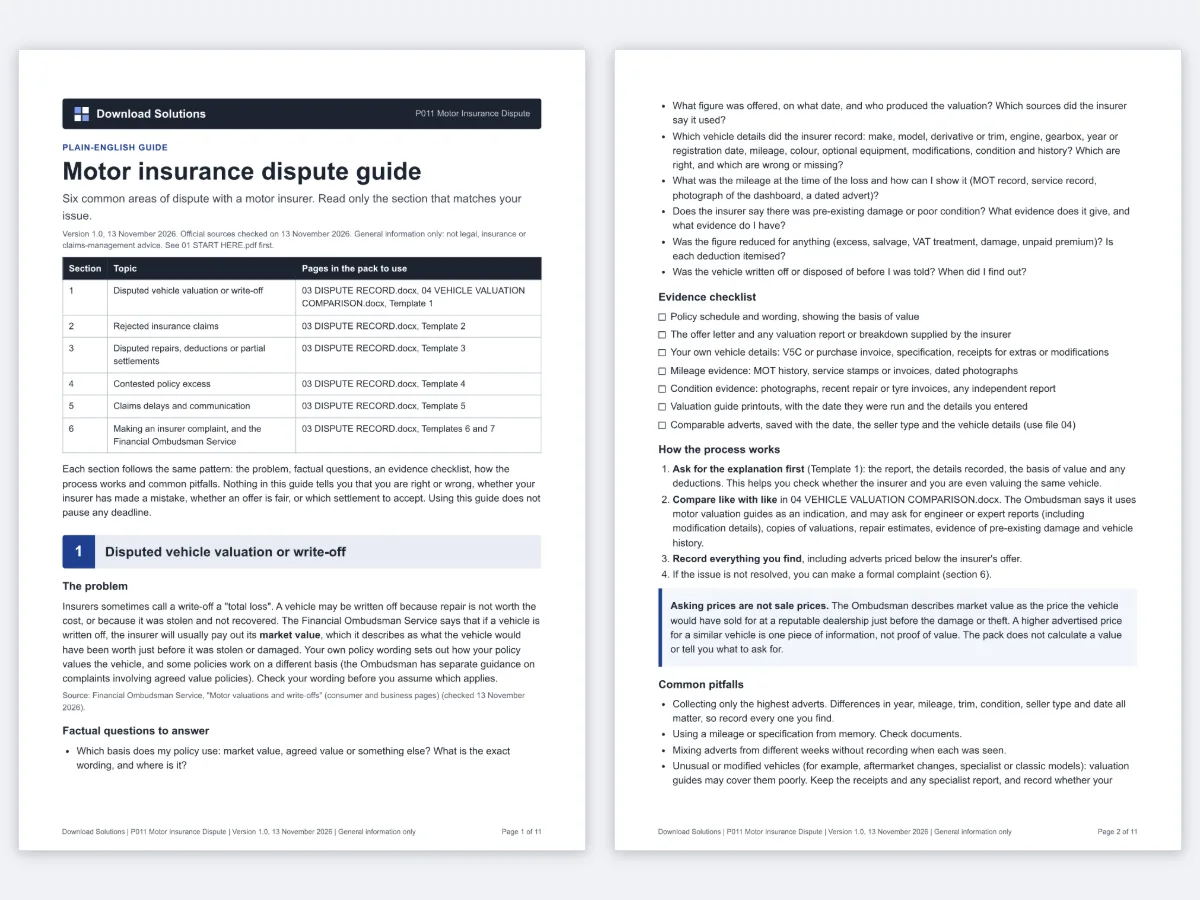
The contents page of the guide listing its six sections, beside a guide page showing questions about vehicle details, an evidence checklist and a note that asking prices are not sale prices

02

Understand six common disputes in plain English

An eleven page guide covers a disputed valuation or write-off, a rejected claim, repairs, deductions and part-payments, a contested excess, claims delays and making a complaint. Each section sets out the problem, the factual questions to answer, an evidence checklist, how the process works and common pitfalls. Valuation gets the most detail. The guide cites the FCA rules and Financial Ombudsman guidance it relies on, checked on 13 November 2026.

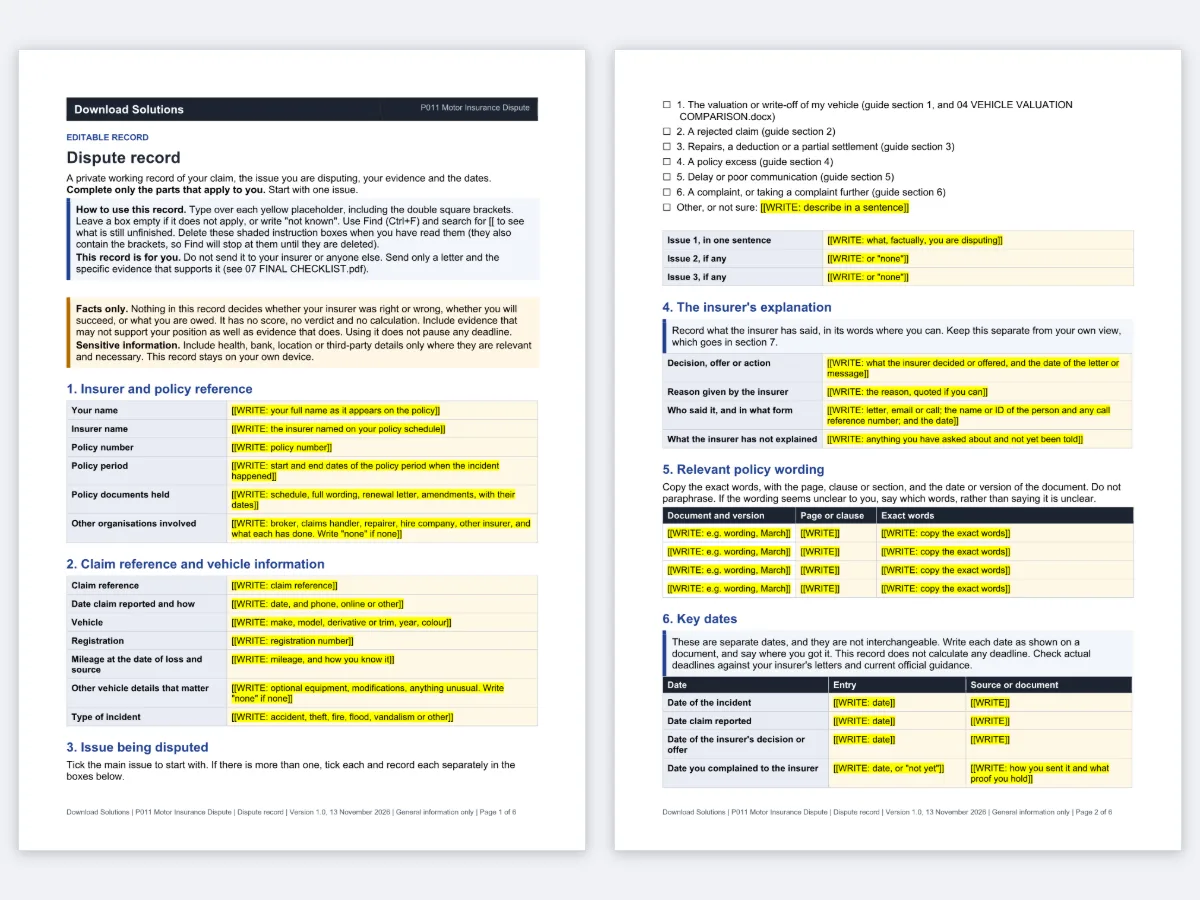
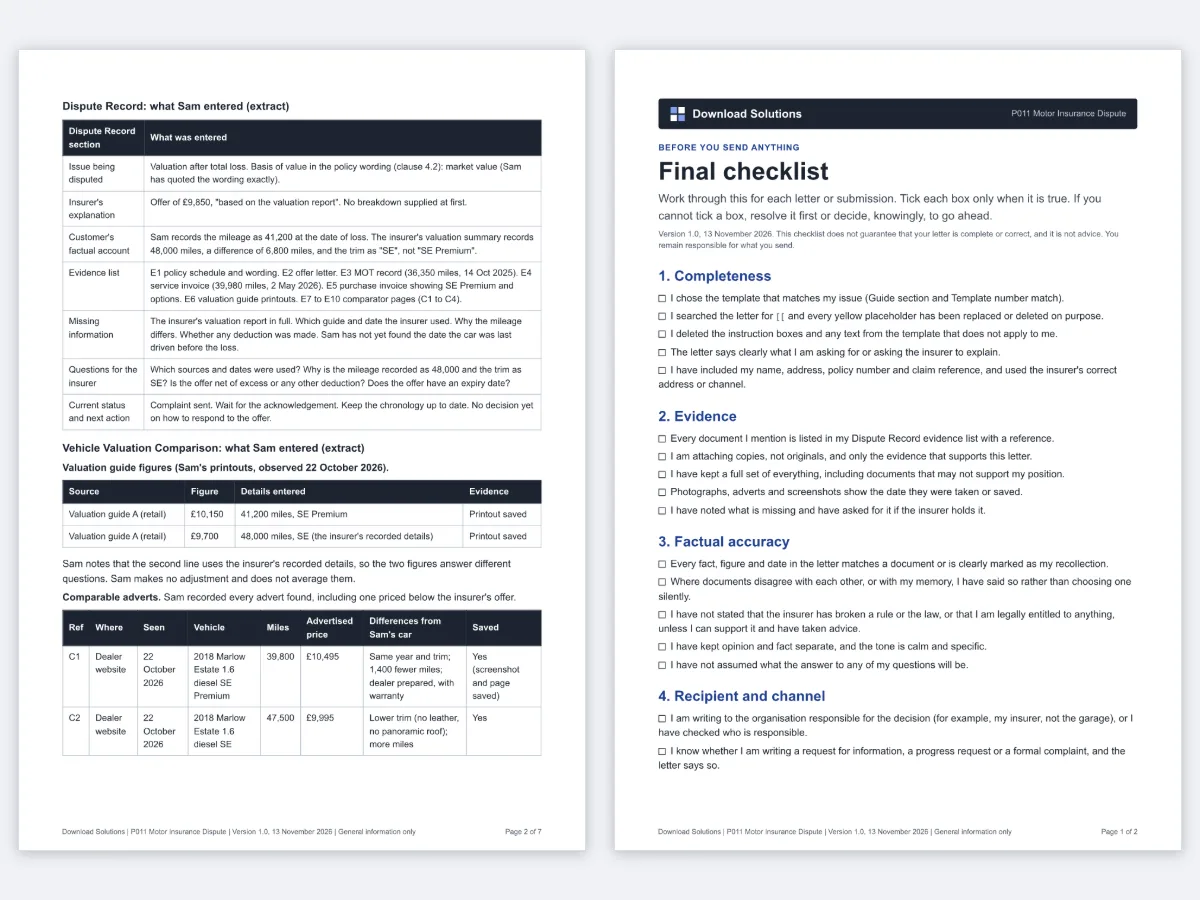
The first two pages of the Dispute record in Word, with yellow placeholders to fill in for the insurer and policy, the claim and vehicle, the issue being disputed and the key dates

03

Record the facts in one place

An editable Word record with thirteen sections: the insurer and policy, the claim and vehicle, the issue, what the insurer said, the exact policy wording, your key dates, your account, your evidence, what is missing, questions, a chronology with call references, any figures and where things stand. It holds facts only. It has no score and makes no decision about who is right.

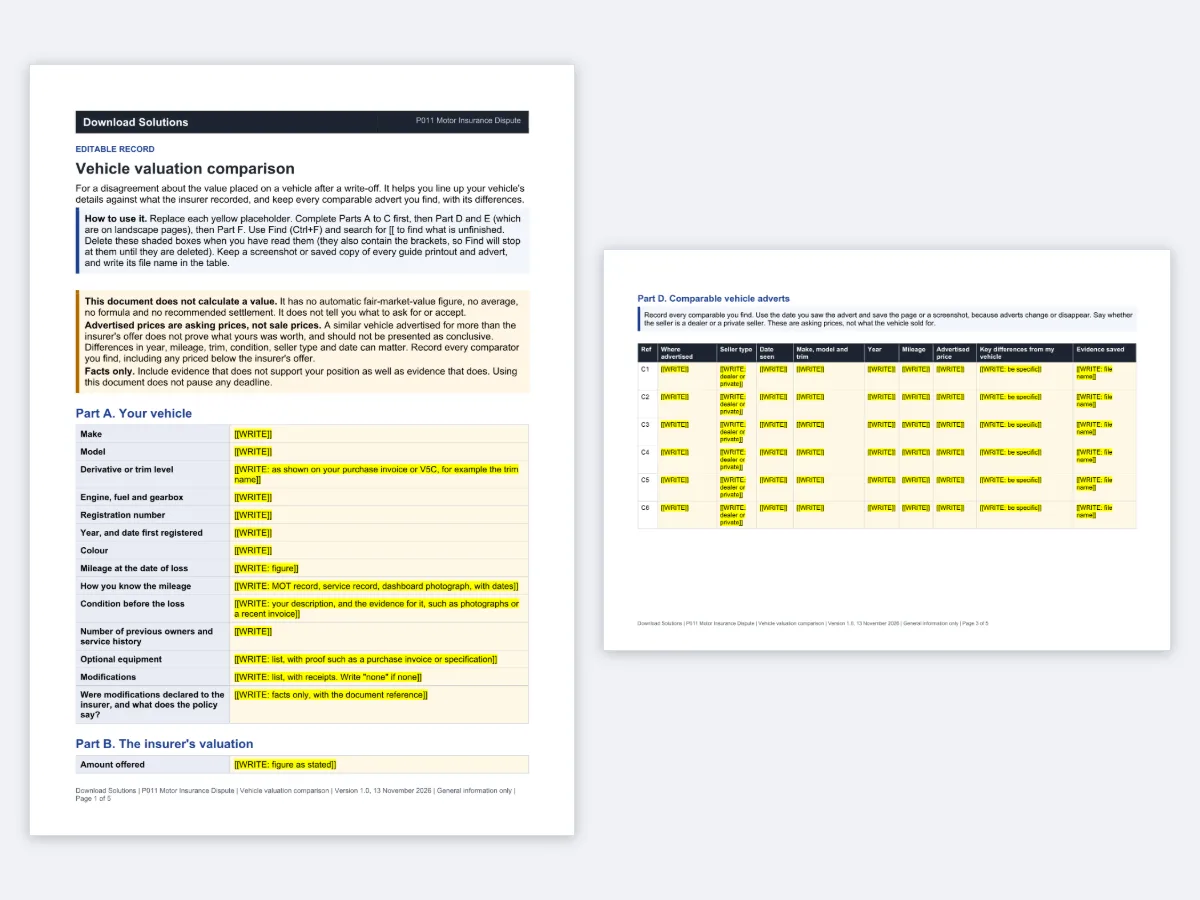
The first page and the landscape comparable adverts page of the Vehicle valuation comparison in Word, with a table for the vehicle details and a table for comparable adverts with mileage, price and differences

04

Compare the insurer's valuation with your own details

An editable Word table for a write-off valuation. List your vehicle's details beside what the insurer recorded, note any valuation guide figures, and record each comparable advert with its mileage, trim, seller and differences. It keeps every advert, including any priced below the offer, and it does not calculate a value. Advertised prices are asking prices, not sale prices.

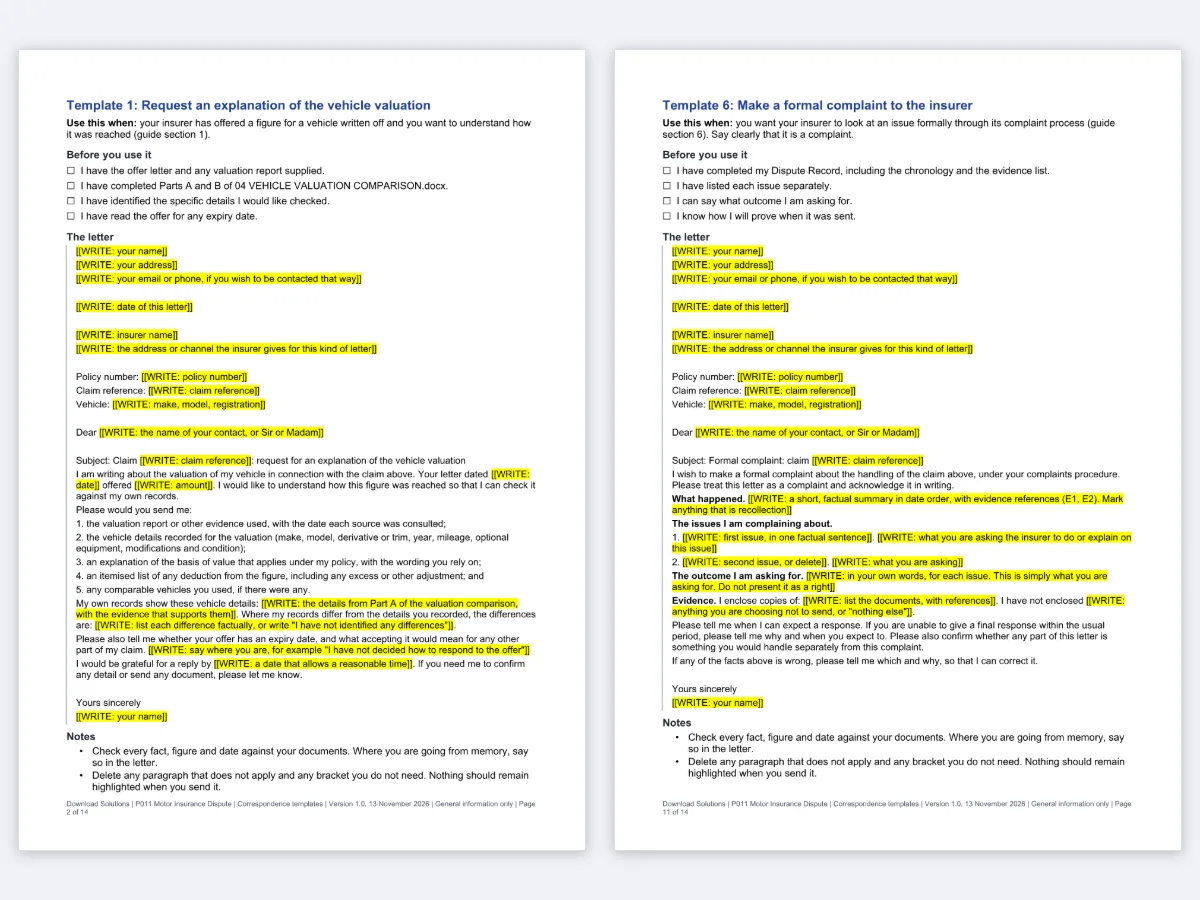
Template 1, a letter asking the insurer to explain a vehicle valuation, beside Template 6, a formal complaint letter, both with yellow placeholders to complete

05

Seven letter templates you check and send yourself

Editable Word letters ask the insurer to explain a valuation, clarify a refusal, explain repair concerns or a deduction, explain an excess or give a progress update, plus a formal complaint and a factual summary to prepare for a possible Ombudsman referral. They ask questions and describe facts. They do not accuse or claim entitlement, and each placeholder in yellow needs your own checked facts.

A page of the worked examples showing a fictional completed dispute record and valuation comparison, beside the first page of the final checklist with tick boxes

06

Worked examples, and a final check before you send

Three completed examples using invented people and insurers show neutral record keeping for a disputed valuation, a refused claim and a delayed repair, with the dates kept apart. A two page final checklist helps you check your evidence, facts, recipient, dates, sensitive information and your own review. The examples do not predict any outcome.

Is it right for you?

A good fit if

  • You have a private car or motorcycle insured on a consumer policy in your own name, and your disagreement is with your own insurer.
  • You have an offer, a refusal, a deduction, an excess or a delay that you want to understand, and you want to approach it in an organised way.
  • You want to line up an insurer's valuation against your own vehicle details and any adverts you have found, keeping every one, including any that do not help you.
  • You want editable letters that ask clear questions, which you check and send yourself.
  • You use Microsoft Word on a Windows computer and a PDF reader.

Not the right choice if

  • Your dispute is mainly with a broker, a garage, a finance company or the other driver's insurer. The pack is written for a dispute with your own insurer, and who can complain to the Financial Ombudsman Service can differ, so check what it helps with first.
  • You have been sent court papers, or you want to start or defend court action. Court deadlines can be short and are different from complaint deadlines, and the pack does not cover them. Get independent legal advice promptly.
  • You have an injury claim, a business or fleet policy or a motor finance commission issue, or you want help buying insurance. These are outside the pack.
  • You want someone to tell you whether your insurer was wrong, whether an offer is fair, what you are owed or which settlement to accept. The pack cannot, and nothing in it promises a result.
  • You will be using a Mac, a phone, a tablet, Google Docs or LibreOffice. The Word files have only been tested in Microsoft Word on Windows.

What is in the download

Start here (PDF)
Five pages to read first: what the pack does and does not do, whether it fits your situation, your starting point, documents to gather, eight steps, time limits, privacy and free help.
Motor insurance dispute guide (PDF)
Eleven pages on six common areas, with a key terms list and the official sources used, checked on 13 November 2026.
Dispute record (Word)
An editable record with thirteen sections for the claim, the dispute, your evidence, your dates and your questions.
Vehicle valuation comparison (Word)
An editable table, with landscape pages for comparable adverts, for lining up the insurer's valuation against your own vehicle details. It does no calculation.
Correspondence templates (Word)
Seven editable letters and summaries: valuation explanation, refusal clarification, repair or deduction concerns, excess explanation, progress update, formal complaint and a factual summary for a possible Ombudsman referral.
Worked examples (PDF)
Seven pages with three fictional completed examples: a disputed valuation, a refused claim and a delayed repair.
Final checklist (PDF)
Two pages of tick boxes to work through before you send anything.

PDF, Word (.docx). Word files tested in Microsoft Word (Microsoft 365) on Windows. PDF files tested in Microsoft Edge on Windows. Not tested on a Mac, a phone or tablet, in Google Docs, in LibreOffice or with screen-reading software. No macros. Version 1.0.1, last updated 13 November 2026.
Before you buy: the limitations

  • It is a self-help pack for organising your information and preparing your own letters. It is general information, not legal, insurance or claims-management advice. It does not decide whether your claim is valid, whether your insurer has made a mistake, whether an offer is fair, what you are owed or what to accept. It does not contact your insurer or the Financial Ombudsman Service for you and submits nothing to anyone. No regulator, ombudsman or insurer produced, endorsed or approved it, and you remain responsible for checking and sending your own correspondence.
  • You do not need this pack to complain. Complaining to your insurer is free, and the Financial Ombudsman Service is a free service for complaints it can consider. Its website says you do not need to pay anyone to represent you, such as a lawyer or a claims management company.
  • The FCA's consumer pages say you can make a claim yourself without a claims management company, and that using one involves a fee.
  • Using the pack does not pause any deadline, whether in your policy, in a settlement offer or in the complaint process. It has no deadline calculator. It explains the usual eight-week and six-month periods in general terms, but the dates that apply to you are on your own letters and in current official guidance.
  • It does not value your vehicle. The valuation comparison records details and adverts and does no calculation. Advertised prices are asking prices, not sale prices, and a similar vehicle advertised for more than an offer does not show what yours was worth.
  • It covers disputes with your own insurer about private cars and motorcycles on consumer policies. It does not cover business or fleet policies, injury claims, motor finance, buying insurance or court action, and court time limits are not covered. Who can use the Financial Ombudsman Service can differ, so check its website.
  • The rules and guidance it describes were checked on 13 November 2026, and the guide lists its sources. Rules can change, so check the current official guidance if you are reading much later. We found no regulator or Ombudsman guidance on excesses to cite, so the excess section of the guide is a record-keeping exercise only.
  • The Word files were tested in Microsoft Word (Microsoft 365) on Windows, and the PDFs in Microsoft Edge on Windows. They have not been tested on a Mac, a phone or tablet, in Google Docs, in LibreOffice or with screen-reading software, so they may not look or work the same there. The pack does not send your information anywhere: what you type stays in the files on your own computer, and we do not want your documents or personal details. Think carefully before you put health, bank or third-party details into any file you share.

Questions

Will this pack get my claim paid or my offer increased?

No. The pack helps you organise your evidence, record the facts and prepare your own letters. It does not decide whether your insurer is right, and nothing in it can promise or predict an outcome.

Do I need it to complain or to go to the Financial Ombudsman Service?

No. You can complain to your insurer directly, and the Financial Ombudsman Service is free for complaints it can consider. You do not need to pay anyone to represent you. The pack is for people who would like help getting organised.

Does this pack give advice about my particular claim?

No. It provides general information, editable templates and record-keeping tools. It does not assess your case, tell you whether your insurer is wrong, recommend a settlement or contact your insurer or the Ombudsman for you. You check and send your own letters. If your case involves an injury, court papers or a large sum, consider independent advice.

Will it stop a deadline from running?

No. Using the pack does not pause or extend any deadline. It does not calculate deadlines either. The pack explains the usual eight-week and six-month periods in general terms, and asks you to keep four dates apart: the incident, your complaint, the insurer's final response and any referral. Check the dates on your own letters.

What files do I get, and what software do I need?

Seven files in one download: four PDFs (the Start here guide, the dispute guide, the worked examples and a final checklist) and three editable Word files (the dispute record, the valuation comparison and the letter templates). You need Microsoft Word to edit the Word files, as tested on Windows. The PDFs open in an ordinary PDF reader.

Will it work on a Mac or in Google Docs?

It has not been tested there. The Word files were tested in Microsoft Word (Microsoft 365) on Windows only, and the PDFs in Microsoft Edge on Windows, so they may not look or work the same on a Mac, a phone or tablet, in Google Docs or in LibreOffice.

What if I am not sure which problem I have?

Start with the table in the Start here guide, which matches six common problems to a guide section and a letter template. Choose the main one, and record any others as separate issues in the dispute record. You do not need to complete anything that does not apply.

Does it cover other parts of the UK?

It is written for UK consumers with private cars and motorcycles, but it has not been checked for differences between England, Wales, Scotland and Northern Ireland beyond the points in the guide, and it does not cover court action. Court time limits differ between the nations. Check your own letters and the official sources.

Buy once, keep the files

One-off payment. Ready to download straight away, with the link emailed to you.

£9.99

Buy and download