01
Check your project against HMRC's tests
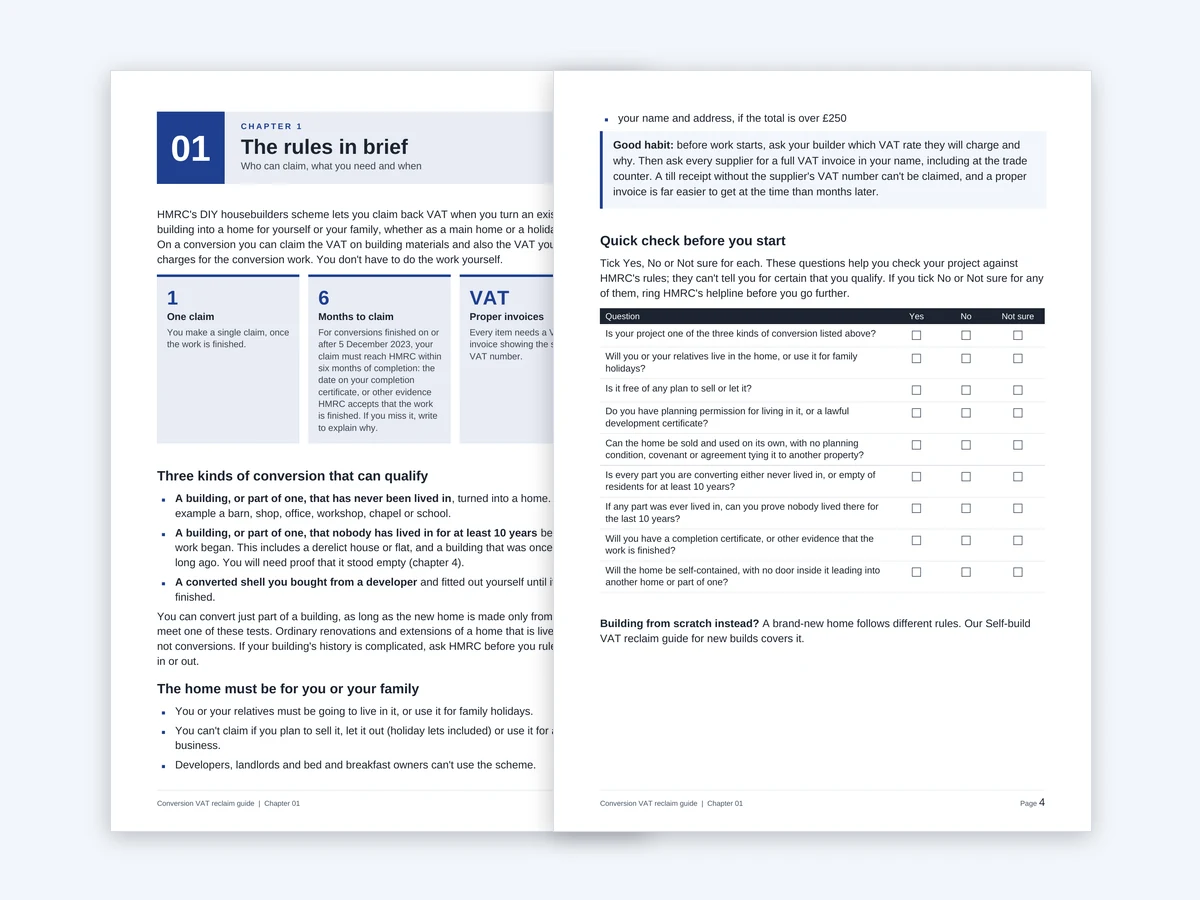
The guide sets out the three kinds of conversion the scheme covers, in HMRC's own terms, with a quick check to tick through and the warning signs to raise with HMRC before you rely on a refund.
Property and building
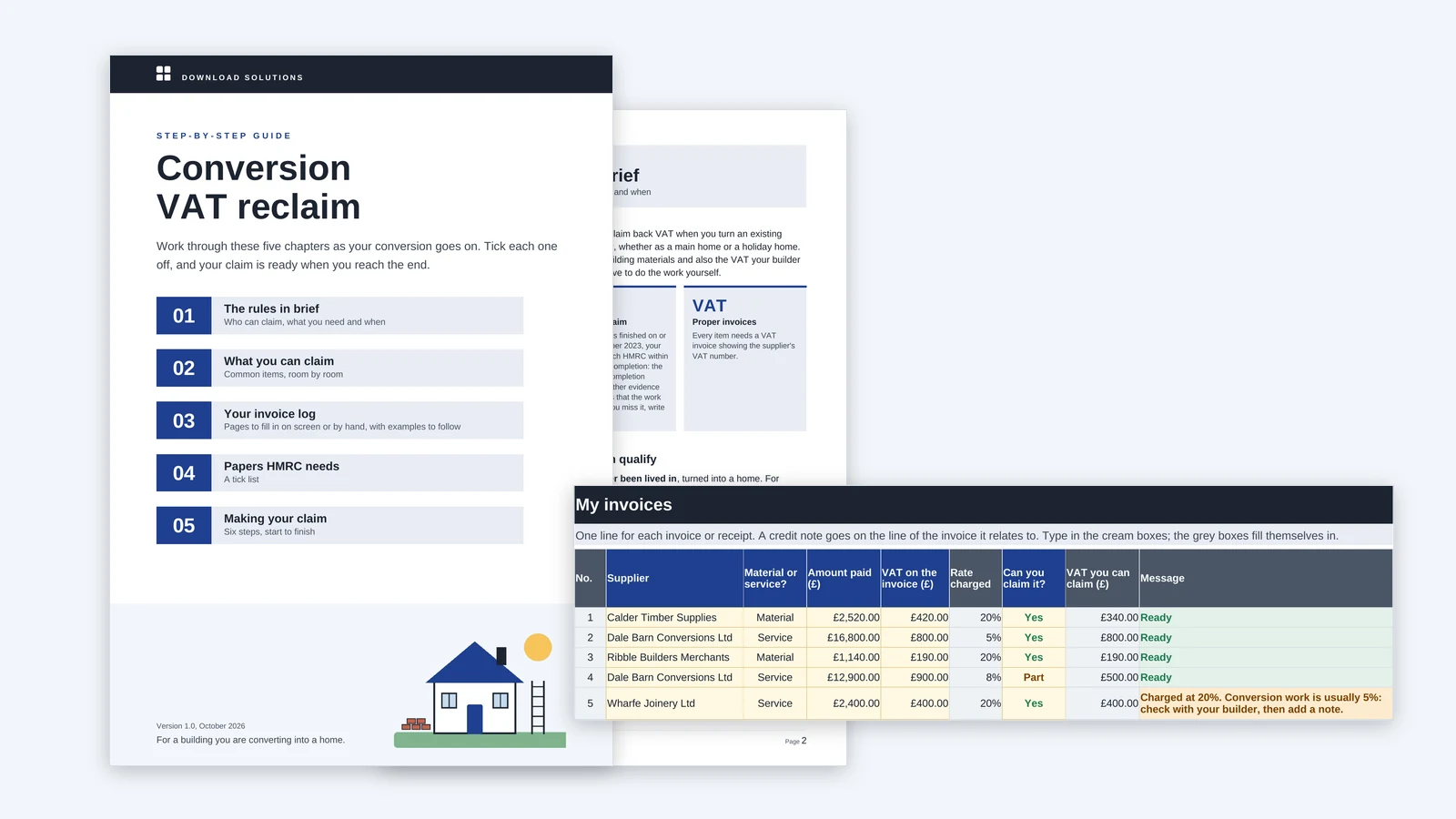
A step-by-step guide to claiming back the VAT on your conversion, with an optional tracker that checks your invoices and sets them out the way HMRC asks.
£29.00
Buy and downloadFor customers in the UK only.
One-off payment. Instant download, with the link emailed to you. Digital product, nothing is posted.
Microsoft Word (.docx), PDF, Microsoft Excel (.xlsx). The tracker has not yet been tested on a Mac. Read the limitations before you buy
The problem
Under HMRC's DIY housebuilders scheme, you can claim back VAT when you turn a building into a home for yourself or your family, such as a barn, a former shop, office or chapel, or a house nobody has lived in for at least 10 years. Unlike a new build, where builders' work should carry no VAT, a qualifying conversion may also let you claim the VAT on your builder's eligible conversion work, as well as on materials. You make one claim, online or on form VAT431C, and for a conversion finished on or after 5 December 2023 it must reach HMRC within six months of completion.
HMRC only refunds VAT that was charged correctly, on a proper VAT invoice, for something the scheme covers. A builder who charges 20% on work that may have qualified for 5%, an invoice that mixes things you can and can't claim, or missing proof that a building stood empty can each cost you money, and they are far easier to put right during the work than months later.
And for an online claim, HMRC asks for every invoice in its own spreadsheet template.
01
The guide sets out the three kinds of conversion the scheme covers, in HMRC's own terms, with a quick check to tick through and the warning signs to raise with HMRC before you rely on a refund.
02
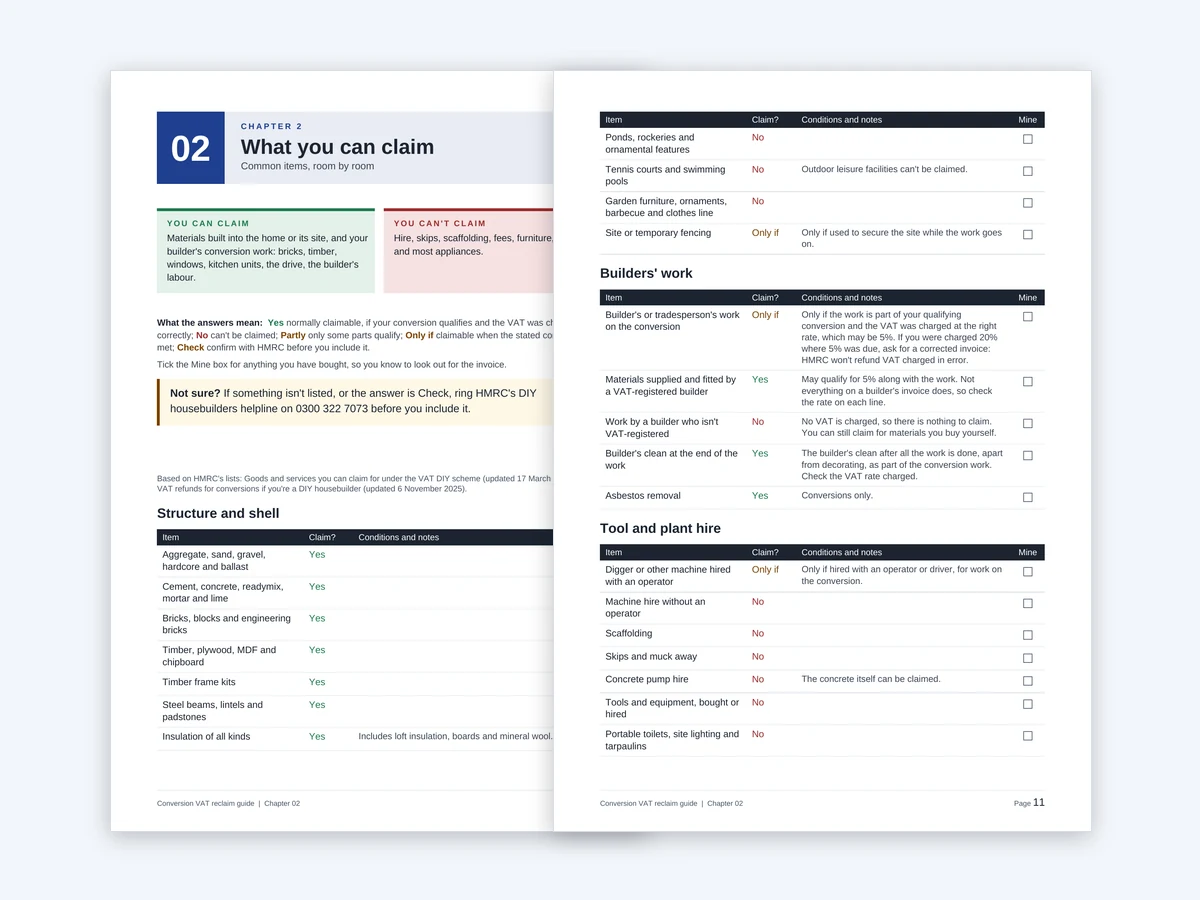
Over 120 common items, room by room, each marked Yes, No, Partly, Only if or Check, with a section on the builder's work that conversions allow you to claim.
03
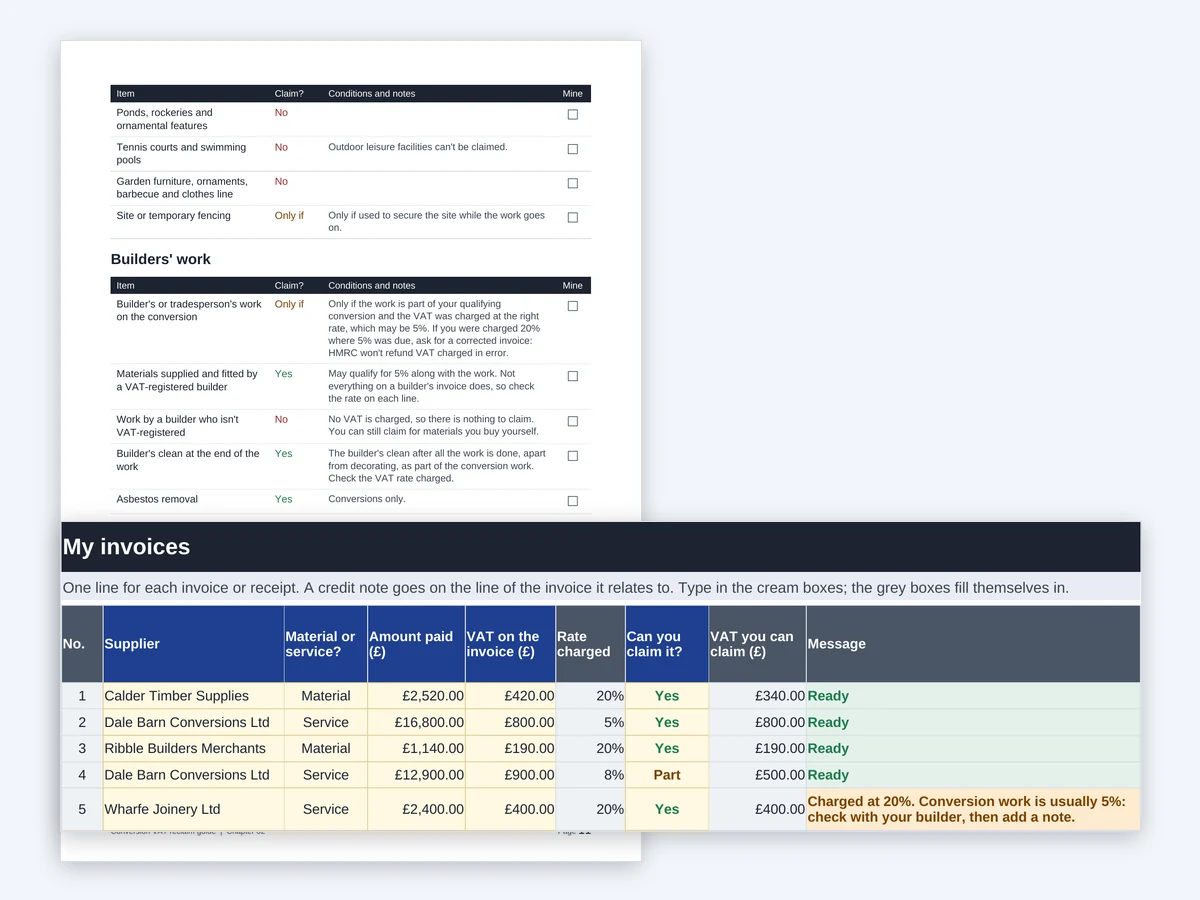
A VAT-registered builder's conversion work may qualify for 5%. The guide shows you how to check the rate on each invoice, and the tracker flags work charged at 20% so you can ask about it before you pay.
04
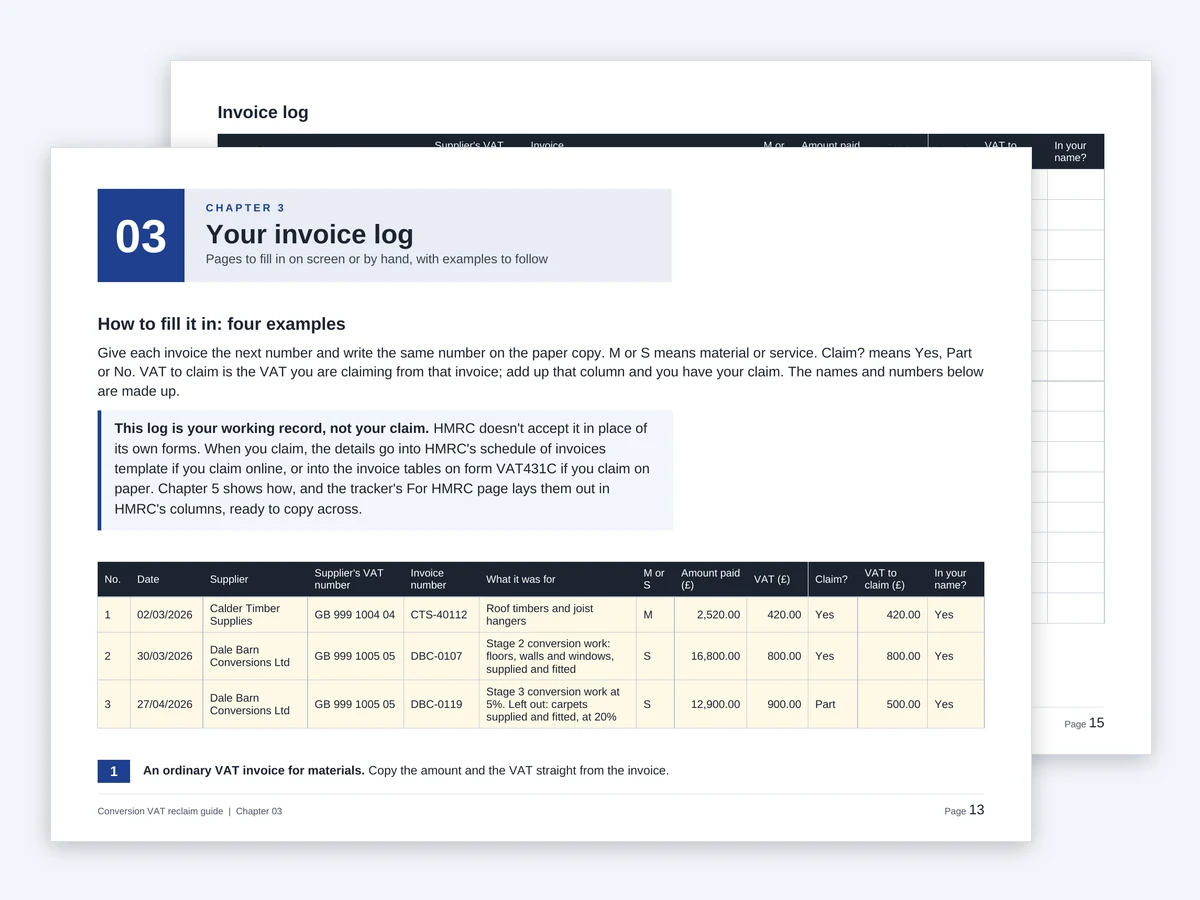
Write each invoice in the printed log as it arrives, or type it into the tracker. Worked examples show how to record an invoice with two VAT rates and a credit note.
05
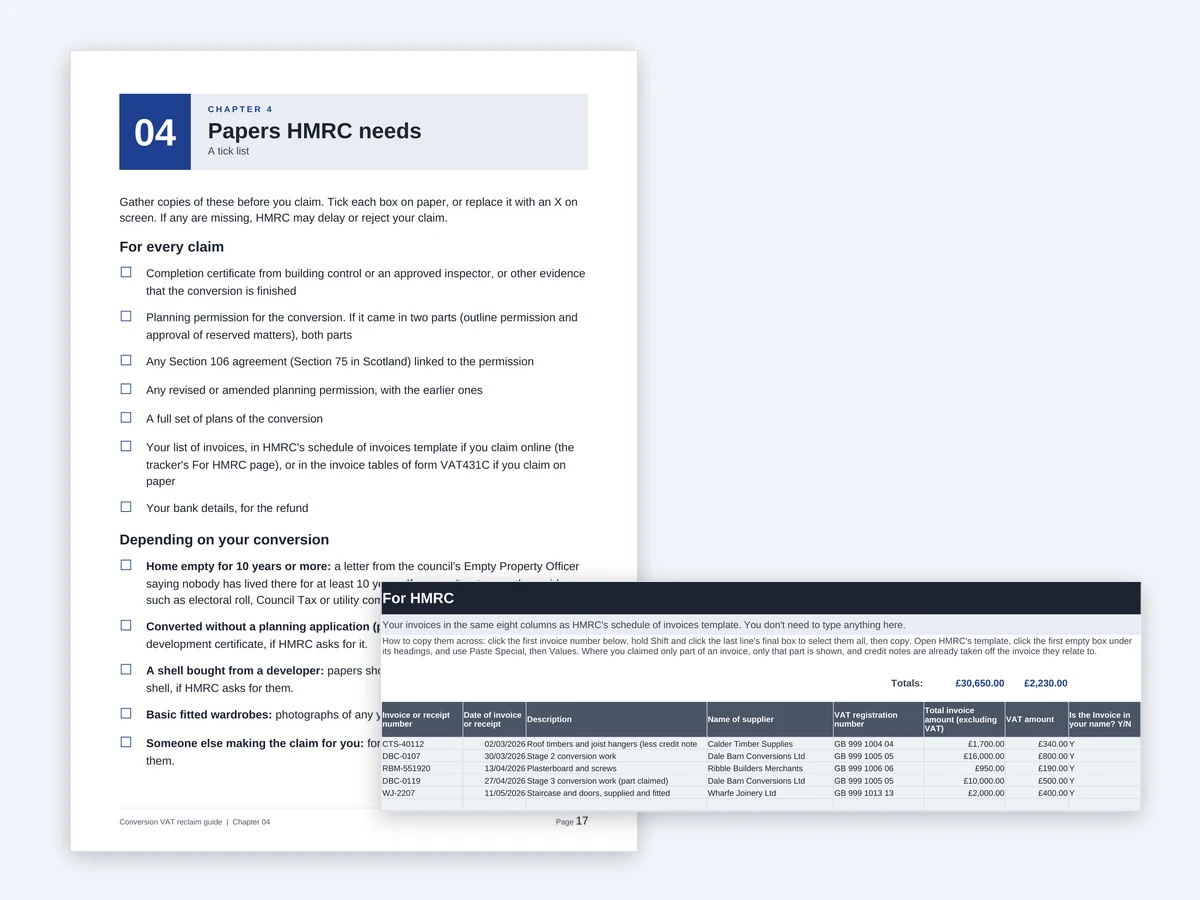
The tick list covers the papers for your kind of conversion, including proof that a building stood empty. The tracker counts down your six months and sets out your invoices in HMRC's eight columns, ready to copy across.
Microsoft Word (.docx), PDF, Microsoft Excel (.xlsx). The tracker has not yet been tested on a Mac. Version 1.1, last updated 18 October 2026.
Yes, along with other buildings that have never been lived in, such as shops, offices, workshops and chapels, buildings nobody has lived in for at least 10 years, and shells bought from a developer. Not every barn conversion qualifies, so chapter 1 helps you check yours against HMRC's tests before you rely on a refund.
On a qualifying conversion, often yes. A VAT-registered builder's conversion work may qualify for the lower rate of 5%, and you can claim VAT that was charged correctly. If you were charged 20% where 5% was due, HMRC won't refund the difference, so the guide shows you how to check the rate before you pay.
It's HMRC's paper claim form for conversions. You can claim online instead, which HMRC deals with more quickly. The guide covers both, including where your invoices go on each.
Mark the invoice as Part and record the amount you can claim, with the VAT shown for it on the invoice and a note of what you left out. The worked examples include a builder's invoice with two VAT rates.
No. Everything you need is in the guide, which you can print and fill in by hand. The tracker is optional. It saves you work at the end, because for an online claim HMRC asks for your invoices in its own spreadsheet template.
As early as you can, ideally before work starts, so you can check your builder's VAT rate and ask for proper invoices from the beginning. It still works if you've just finished, but for a conversion finished on or after 5 December 2023 your claim must reach HMRC within six months of completion.
No. You make the claim yourself, online or on form VAT431C. The guide takes you through it step by step, and the tracker sets out your invoices ready to copy into HMRC's template.
One-off payment. Ready to download straight away, with the link emailed to you.
£29.00
Buy and download